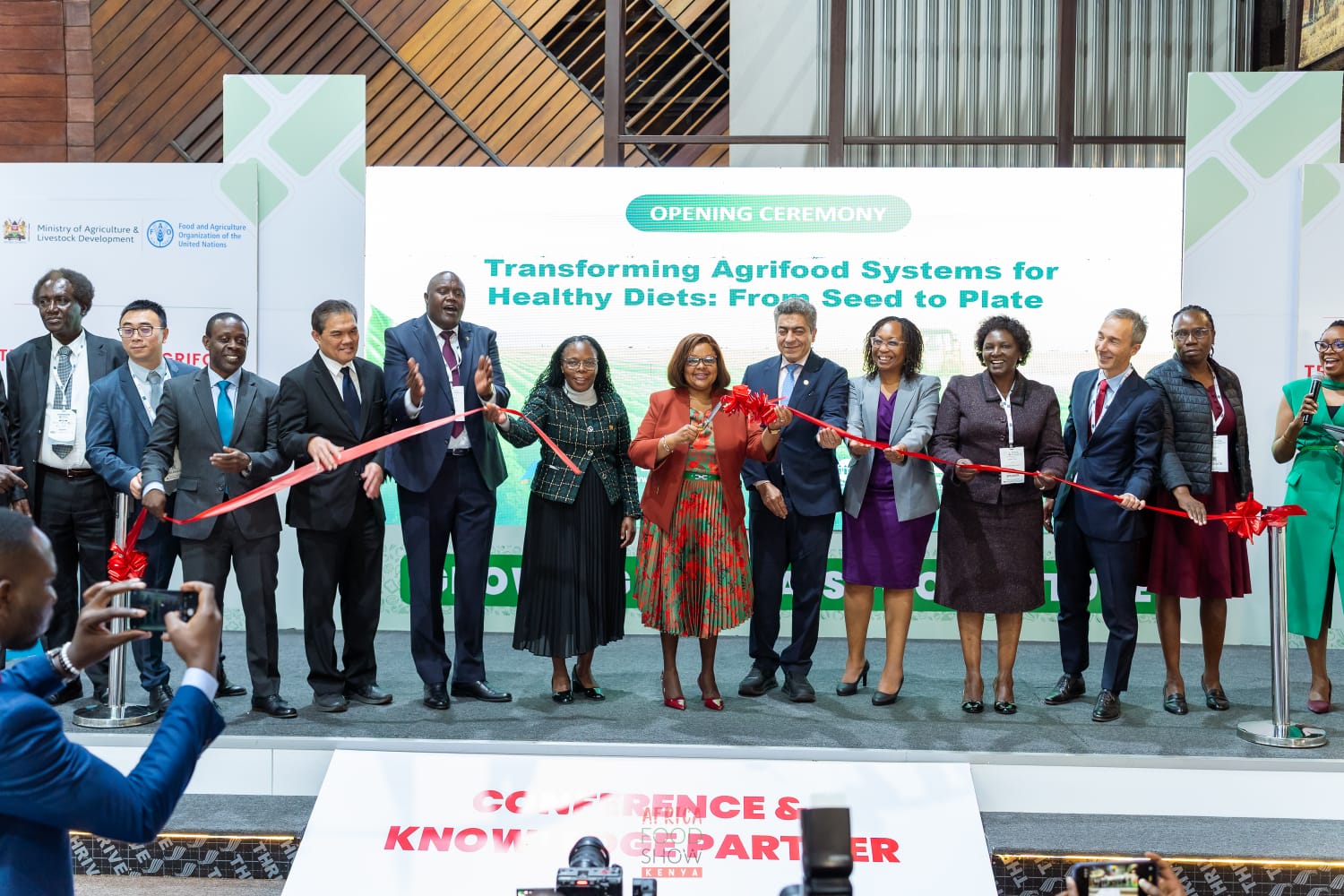


From Left: Kennedy Oketch, Agriculture Economy and Financial Advisor, GIZ Kenya, David Adama, Senior Policy Officer, AGRA, Rashid Khator, Secretary of Administration in the State Department of Agriculture and Peter Owoko, Director of Policy at the State Department of Agriculture, Ministry of Agriculture during the FINAS2026 media launch on 27th April , 2026 in Nairobi.
Kenya Unveils Bold Plan to Close Sh13 Trillion Agricultural Financing GapNAIROBI, Kenya — The Government of Kenya has unveiled an ambitious roadmap aimed at closing the estimated Sh13 trillion (US$100 billion) annual financing gap that continues to constrain Africa’s agricultural sector.
The strategy was outlined during the official media launch of the Financing Agri-food Systems Sustainably (FINAS) 2026 Summit in Nairobi, where government officials and sector leaders called for a fundamental shift toward bankable, data-driven investments targeting smallholder farmers.
The pan-African summit, scheduled for June 30 to July 2, 2026, seeks to dismantle systemic barriers that have left nearly 80 percent of the continent’s food producers excluded from formal financial systems.
Driving Investment Through Data
A key highlight of the launch was the government’s push to leverage data as a tool to de-risk agriculture and attract private capital.
Speaking on behalf of Principal Secretary for Agriculture Dr. Paul Ronoh, Harun Khator, Secretary of Administration at the State Department for Agriculture, announced plans to transform the Agricultural Resources Centre into the Centralized Agricultural Data and Information Centre (CADIC), a move expected to enhance sector transparency and boost investor confidence.
“Without data, you’d be grumbling in the dark to make the right decision. CADIC will consolidate critical agricultural data, making it easier for institutions to conduct research and enabling the government to formulate more effective policies.”Khator said.
Khator said agriculture remains the backbone of national stability, underscoring the urgency of empowering smallholder farmers through targeted and impactful financing frameworks.
“We have seen it today that without agriculture, nothing else moves . This is why we must empower small-scale farmers with financing policies that deliver real impact.” He said.
Tackling the High Cost of Credit
Beyond data visibility, stakeholders raised concerns over the prohibitive cost of credit, which continues to limit agricultural productivity.
Agricultural Finance Corporation (AFC) Managing Director George Kubai noted that while agriculture contributes up to 30 percent of GDP in many African countries, it receives less than 5 percent of formal lending.
“Eighty percent of Kenya’s agriculture is informal and informal means invisible to commercial banks . That invisibility locks out the majority of farmers from accessing finance.”Kubai said.
He stressed that de-risking alone is insufficient, calling for deliberate interventions to lower borrowing costs.
“We cannot finance agriculture at double-digit interest rates . We must move toward subsidised models through blended finance or direct government support to make credit affordable.” He said.
From Commitments to Action
The FINAS platform, which began as a national dialogue in 2024, has since evolved into a continental initiative focused on delivering measurable outcomes.
Professor Hamadi Boga, Vice President at AGRA and Chair of the FINAS Secretariat, said the 2026 summit marks a shift from pledges to implementation.
“FINAS 2026 is about moving beyond commitments to coordinated delivery,” It provides a platform to unlock capital at scale and translate policy ambitions into investments that reach farmers and agri-enterprises.”Boga said.
He added that the summit will prioritise inclusive financing models that benefit women and youth while ensuring investments deliver tangible results.
“Financing must be results-oriented, ensuring every shilling invested creates measurable value and advances agri-food sustainability,” he said.
Building Resilient Food Systems
The summit will be anchored on four key pillars: policy alignment, innovative financing, green resilience and trade facilitation.
Jared Ochieng’, Agriculture Finance Lead at FSD Kenya, warned that climate change, market volatility and global conflicts are intensifying pressure on Africa’s food systems.
“Food systems across Africa are facing mounting challenges from funding constraints to climate shocks and geopolitical disruptions . We must rethink our approaches and work collectively to build resilient, future-ready systems.”Ochieng’ said.
He said FINAS 2026 will focus on mobilising investment and strengthening policy environments to unlock greater private sector participation.
“We are looking at the policies and enabling frameworks that will attract private capital and drive sustainable investment in agriculture,” he said.
A Turning Point for Food Security
As momentum builds toward the summit, stakeholders agreed that the future of Africa’s food systems hinges on unlocking financing for the “invisible” majority smallholder farmers.
By embracing data-driven solutions, affordable credit and coordinated action, FINAS 2026 is expected to catalyse a shift from subsistence agriculture to a thriving, investment-ready sector.
Ultimately, participants said, the summit’s success will not be measured by attendance figures but by the extent to which smallholder farmers gain access to sustainable financing, increased productivity and improved livelihoods across the continent.