
NIRU Crowns Top Innovators as Kenya’s AI Future Takes Shape at National Hackathon
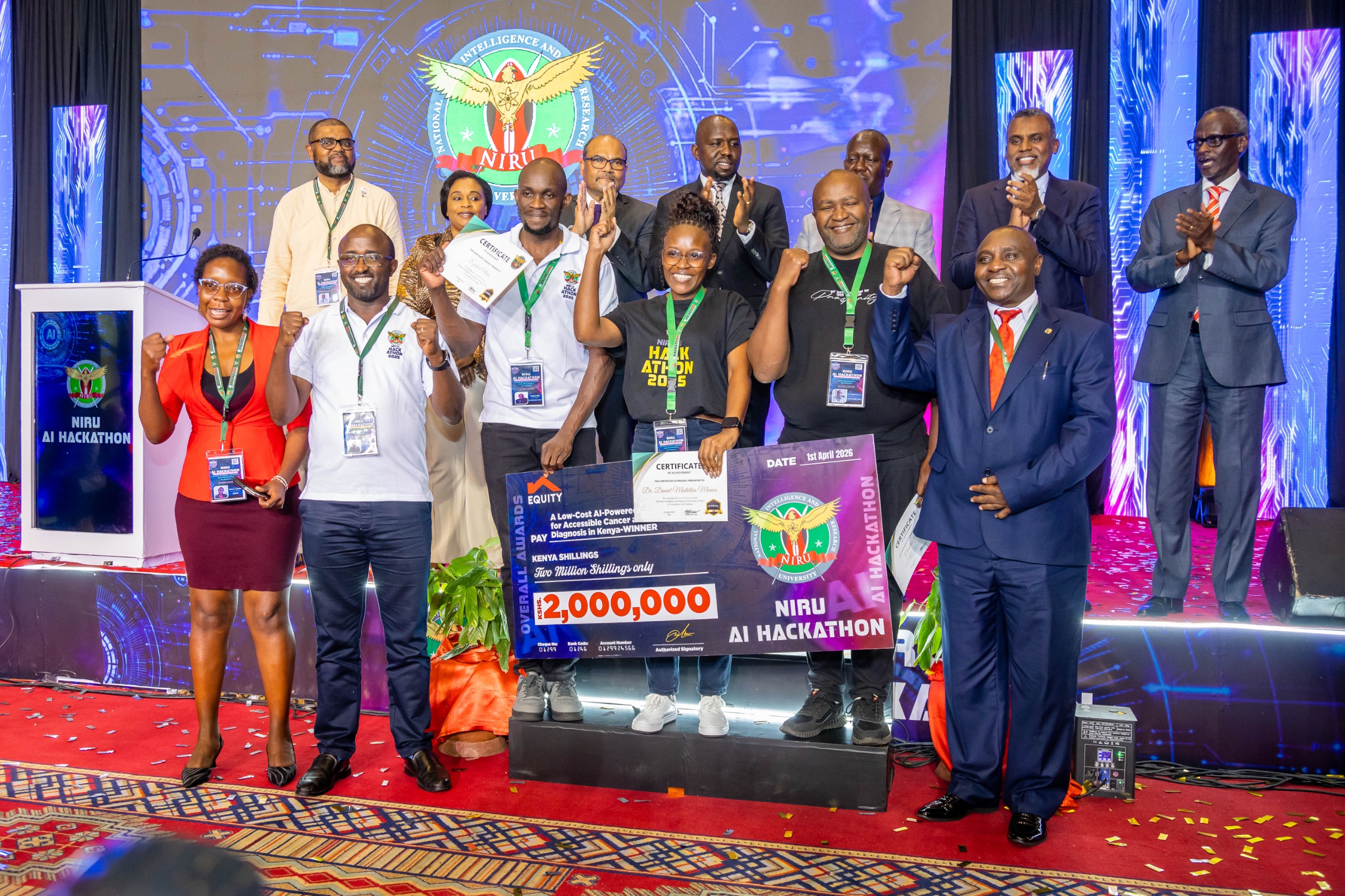
Winners of the 2025 National AI Hackathon pose with Interior CS Kipchumba Murkomen, NIRU Board Chairman Nordin Haji, and other officials during the awards ceremony in Nairobi.
NAIROBI, April 1, 2026 — Kenya has strengthened its push toward artificial intelligence adoption for national development and security following the conclusion of the 2025 National AI Hackathon, organised by the National Intelligence and Research University (NIRU) in Nairobi.
The competition brought together innovators, researchers, and private sector partners to develop practical AI-driven solutions for healthcare, cybersecurity, and public service delivery.
Caroline Gakii, Daniel Maitethia, and Ezekiel Otieno from Meru University of Science and Technology emerged as the overall winners, taking home the KSh 2 million grand prize for their AI-powered digital microscope designed to improve cancer and malaria diagnosis.
A Pillar of National Security
Speaking during the ceremony, Interior and National Administration Cabinet Secretary Kipchumba Murkomen stated that AI is no longer a luxury but a necessity for modern statehood.
“Artificial intelligence is redefining how economies grow, how governments deliver services, and how societies respond to emerging and complex risks,” said Murkomen.
He further emphasized that the nature of protection has shifted into the digital realm, requiring a new generation of experts.
“This expanded security landscape demands new capabilities, new thinking, and new partnerships. We must invest in talent and innovation ecosystems that allow our young people to develop solutions for future national challenges,” he added.
Building Technological Independence
Director General of the National Intelligence Service (NIS) and Chairman of the NIRU Board of Trustees, Noordin Haji, noted that fostering local talent is the only way to ensure national resilience.
“By nurturing AI innovation locally, we are building the capacity to develop solutions that respond directly to our socio-economic realities while strengthening national security,” Haji remarked.
He noted that relying on homegrown systems is a strategic move to keep Kenya competitive on the global stage.
“Homegrown innovation enables us to create systems that understand our context and development priorities, making investment in young innovators an investment in the country’s long-term stability,” he added.
Ethical Adoption and Justice
Supreme Court Judge Justice Isaac Lenaola highlighted the transformative opportunities for the justice sector but urged a cautious, human-centric approach to automation.
“AI is one of the most transformative technologies of this century. When applied responsibly, it has the potential to improve efficiency, enhance service delivery, and support informed decision-making,” Lenaola said.
However, he reminded the audience that technology should not operate in a vacuum without accountability.
“Technology must complement human judgment rather than replace it. As institutions embrace AI, safeguards must be put in place to protect accuracy, fairness, and accountability within justice systems,” he cautioned.
From Ideas to Deployment
NIRU Vice Chancellor Dr. James Kibon explained that the hackathon’s primary goal was to move beyond theory into practical, usable tools for the Kenyan public.
“What we are building through this initiative is not merely a competition but a pipeline of deployable artificial intelligence solutions developed by young innovators to respond to real societal challenges,” Kibon stated.
He called on the academic community to continue bridging the gap between the classroom and the industry.
“Universities must play a central role in nurturing innovation by equipping students with skills that allow them to transform ideas into practical solutions aligned with national development priorities,” he concluded.
The hackathon attracted more than 5,600 registrations and generated over 2,500 submissions nationwide. Following the awards, the winning teams will enter an incubation program to scale their prototypes into fully functional national security and public service tools.