
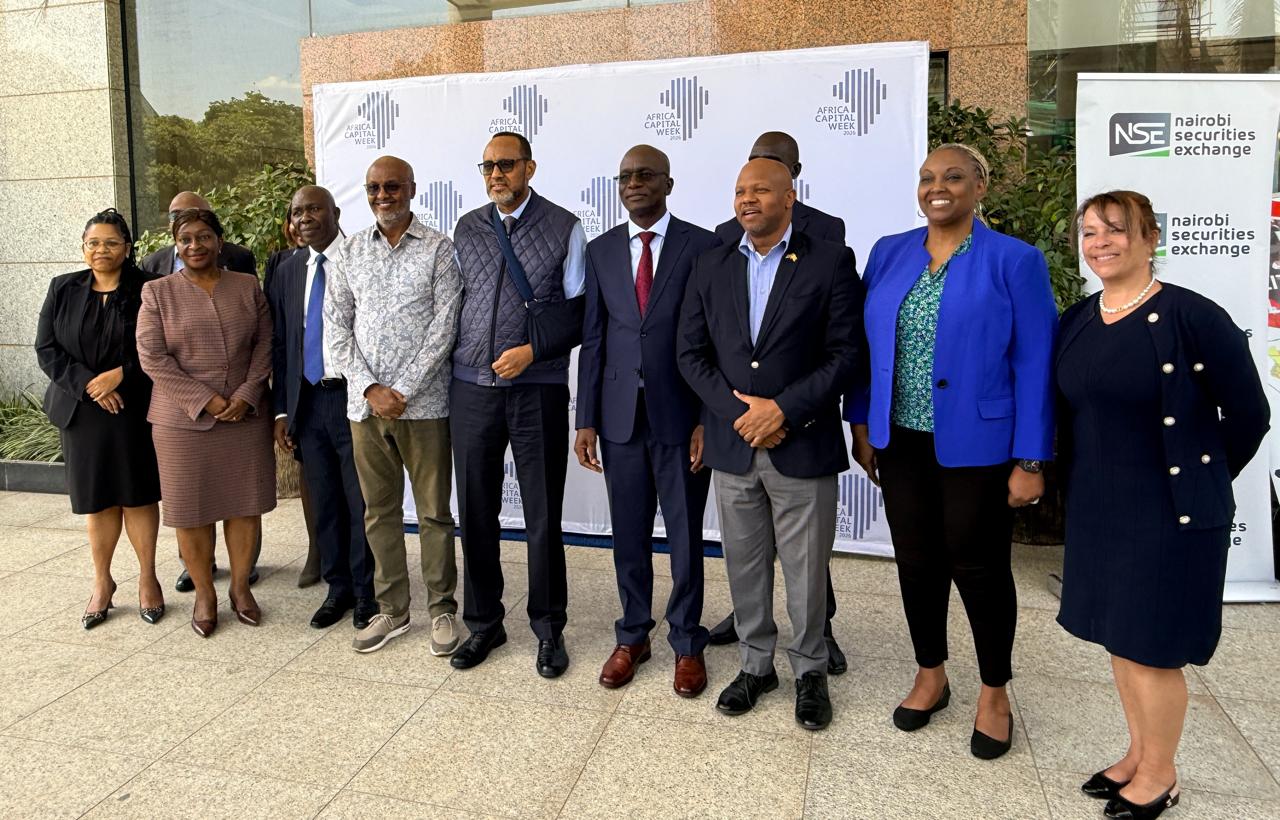
Economic Planning Secretary Bonface Makokha (centre) poses for a group photo with stakeholders during the launch of Africa Capital Week at the Kenya School of Monetary Studies, Nairobi on 15th june 2026.
Kenya is banking on stronger capital markets and increased private investment to finance its development agenda as African leaders push for alternative sources of funding amid concerns over costly external borrowing and limited access to affordable long-term capital.
Speaking during the launch of the initiative in Nairobi , Economic Planning Secretary Bonface Makokha said Africa continues to face significant financing challenges, including the overpricing of sovereign risk and limited access to affordable development financing, issues that recently featured prominently during preparations for the G7 Development Ministers Meeting in Paris.
“One of the key concerns raised by African countries is the lack of access to affordable long-term development financing. Affordable capital remains one of the greatest challenges facing the continent,” said Makokha.
He noted that Africa’s development ambitions continue to be constrained by expensive financing and called for innovative mechanisms to unlock domestic and regional capital.Makokha cited Burkina Faso’s recent diaspora bond as an example of how African countries can mobilize local resources to reduce dependence on costly external financing.
The bond, which sought to raise 125 billion CFA francs, attracted subscriptions worth 151 billion CFA francs within a month.
“We have to appreciate not only the challenges Africa faces in accessing capital but also the opportunities that remain untapped and can be leveraged to attract investment,” he said.
The PS said the upcoming Africa Capital Week will provide a platform for translating commitments made during the Africa Forward Summit 2026 into concrete investment opportunities.Held in Nairobi earlier this year, the summit brought together more than 30 Heads of State and Government, global investors, development partners and private sector leaders to discuss Africa’s economic future.
“Africa is not asking for charity. Africa is asking for fair access to capital. Africa is not seeking sympathy; it is seeking investment,” Makokha said.
He added that Africa Capital Week would help transform policy aspirations into capital flows by bringing together governments, investors, regulators and financial institutions.
“If Africa Forward articulated the vision, Africa Capital Week must build the financial architecture required to deliver it. The task before us is to transform declarations into deals, aspirations into allocations and commitments into capital flows,” he said.
Makokha said Kenya’s economy expanded by 4.6 per cent in 2025, with nominal Gross Domestic Product reaching approximately Sh17.58 trillion, and highlighted infrastructure, renewable energy, digital transformation, manufacturing, agribusiness and affordable housing as key investment priorities.
He noted that public debt currently exceeds 60 per cent of GDP, underscoring the need to deepen capital markets and attract long-term private sector financing.
To bridge financing gaps, the government is implementing initiatives such as the Nairobi International Financial Centre, the National Infrastructure Fund and measures aimed at mobilizing pension funds, sovereign wealth funds and climate finance.
“The financial sector must be vibrant and globally competitive if we are to mobilize the resources required for our transformation agenda,” he said.
Speaking at the same event, Acting Director General of the Kenya Vision 2030 Delivery Secretariat James Maina said Africa Capital Week will bring together capital market players from across the continent to explore collaborative approaches to resource mobilization.
Maina said mobilizing domestic resources remains central to the implementation of Kenya Vision 2030 and aligns with the aspirations of the African Union’s Agenda 2063.
“The Kenya Vision 2030 sees the mobilization of resources as key in supporting implementation of development priorities. This has to happen through strengthening capital markets and other financial systems associated with them,” he said.
According to Maina, Africa possesses significant untapped resources, including private capital and diaspora investments, that could be harnessed to finance development and reduce reliance on borrowing.
“There is a lot that can be galvanized, including resources held by the diaspora, in a structured manner that benefits both investors and the country,” he said.
The inaugural Africa Capital Week is scheduled to take place in Nairobi from August 31 to September 4 and is expected to bring together policymakers, investors, regulators, stock exchanges and development partners from across Africa.
Maina also called for increased public awareness of investment opportunities, including Initial Public Offerings (IPOs), saying broader participation in capital markets would support economic growth and wealth creation.
“Anybody can invest in IPOs as long as they have resources to invest. Information needs to be disseminated effectively at individual, company and institutional levels,” he said.