

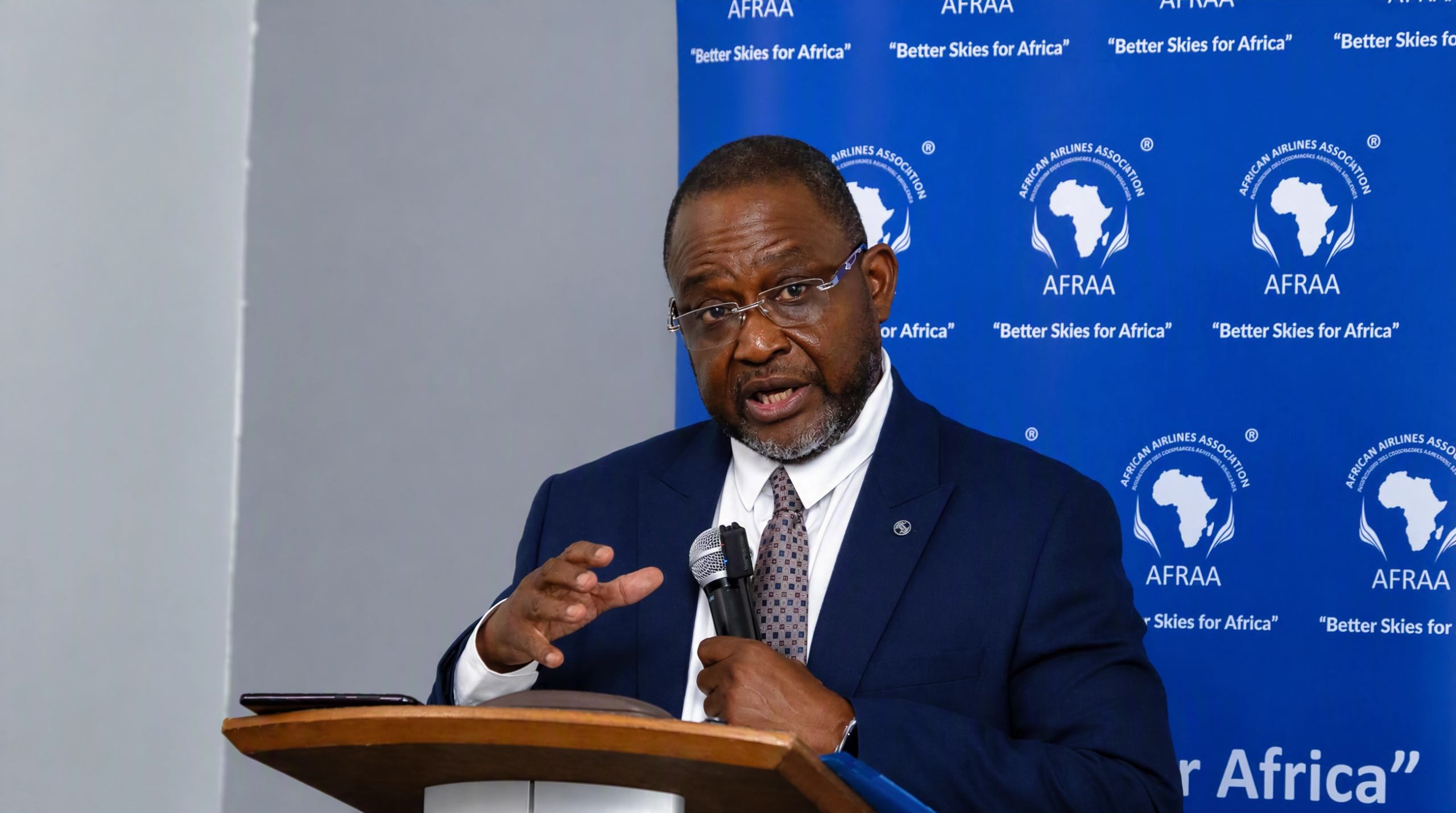
Photo Caption: AFRAA Secretary General Abdérahmane Berthé speaks during a media roundtable in Nairobi on September 10, 2026.
NAIROBI, September 10, 2026 – The African Airlines Association (AFRAA) has called on governments, regional institutions and financing partners to reduce the cost of air transport and improve access to financing to enable African airlines to benefit from growing passenger demand.
AFRAA Secretary General Abdérahmane Berthé said the continent’s aviation industry had significant growth potential but continued to face high operating costs, limited financing, blocked funds and disruptions caused by geopolitical tensions.
Speaking during an AFRAA media roundtable in Nairobi on Thursday themed “Resilient African Aviation: Partnerships – Empowerment – Profitability,” Berthé said governments needed to translate aviation commitments into practical measures that would support airlines.
“African aviation is ready to deliver on its promise to connect our economies, move our trade, and carry the growth that this continent’s youth and enterprise are already generating. But readiness is not the same as capacity,” said Berthé.
He said African airlines were operating on some of the thinnest margins globally while dealing with costs and shocks that were limiting their ability to expand.
“We are calling on governments to release what is owed, to lower the tax burden on air travel, and to convert the liberalisation they have already signed up to into practice on the ground,” Berthé said.
Africa’s passenger traffic is projected to reach 137.3 million in 2026, representing a 21.5 per cent increase from 2025. However, air travel penetration remains at only seven per cent of the continent’s population, highlighting significant room for expansion.
AFRAA said the growth in demand was not translating into equivalent profitability because capacity was expanding faster than traffic. In July 2026, capacity growth stood at 9.0 per cent compared with 5.8 per cent growth in passenger demand, creating pressure on load factors and yields.
The association said taxes, fees and charges account for between 35 and 40 per cent of African airfares, compared with about 20 per cent globally. It also estimated that governments were holding about 774 million US dollars in blocked airline funds as of March 2026.
Berthé said implementing the Single African Air Transport Market (SAATM) would also be critical in improving connectivity and lowering the cost of operating across the continent.
Thirty-eight African countries have signed SAATM, representing close to 80 per cent of the continent’s air traffic. AFRAA is calling for the commitments to be translated into actual market liberalisation, including greater access to routes and stronger cooperation among airlines.
African carriers currently account for 52.8 per cent of international capacity, but their share falls to 37.6 per cent in intercontinental capacity, demonstrating the long-haul gap that the industry needs to address.
The association is promoting the African Airlines Cooperation Framework to encourage member airlines to cooperate on networks, while also seeking financing solutions for fleet renewal in partnership with institutions including Afreximbank and the African Development Bank.
Africa receives only two per cent of global aircraft deliveries despite rising demand, while 67.4 per cent of African aircraft are currently in service and 12.7 per cent are on order.
AFRAA further called for increased investment in aviation infrastructure, safety, airspace efficiency and maintenance, repair and overhaul (MRO) capacity.
The continent requires an estimated 25–30 billion US dollars over the next decade to address airport and air navigation infrastructure gaps, while African airlines spend about 1.8 billion dollars annually on aircraft maintenance outside the continent.
On safety, AFRAA said Africa recorded a 35 per cent improvement in its accident rate in 2025, falling from 12.13 to 7.86 accidents per million flights.
The association is also extending its Free Route Airspace programme to Eastern and Southern Africa after savings recorded in West and Central Africa.
Berthé said stronger partnerships and coordinated action could help the industry convert rising demand into sustainable growth.
“With that support matched at scale, African airlines can do what they do best: drive the growth, resilience and connectivity our continent needs,” he said.


The content is really great
WOW,Very wonderful