
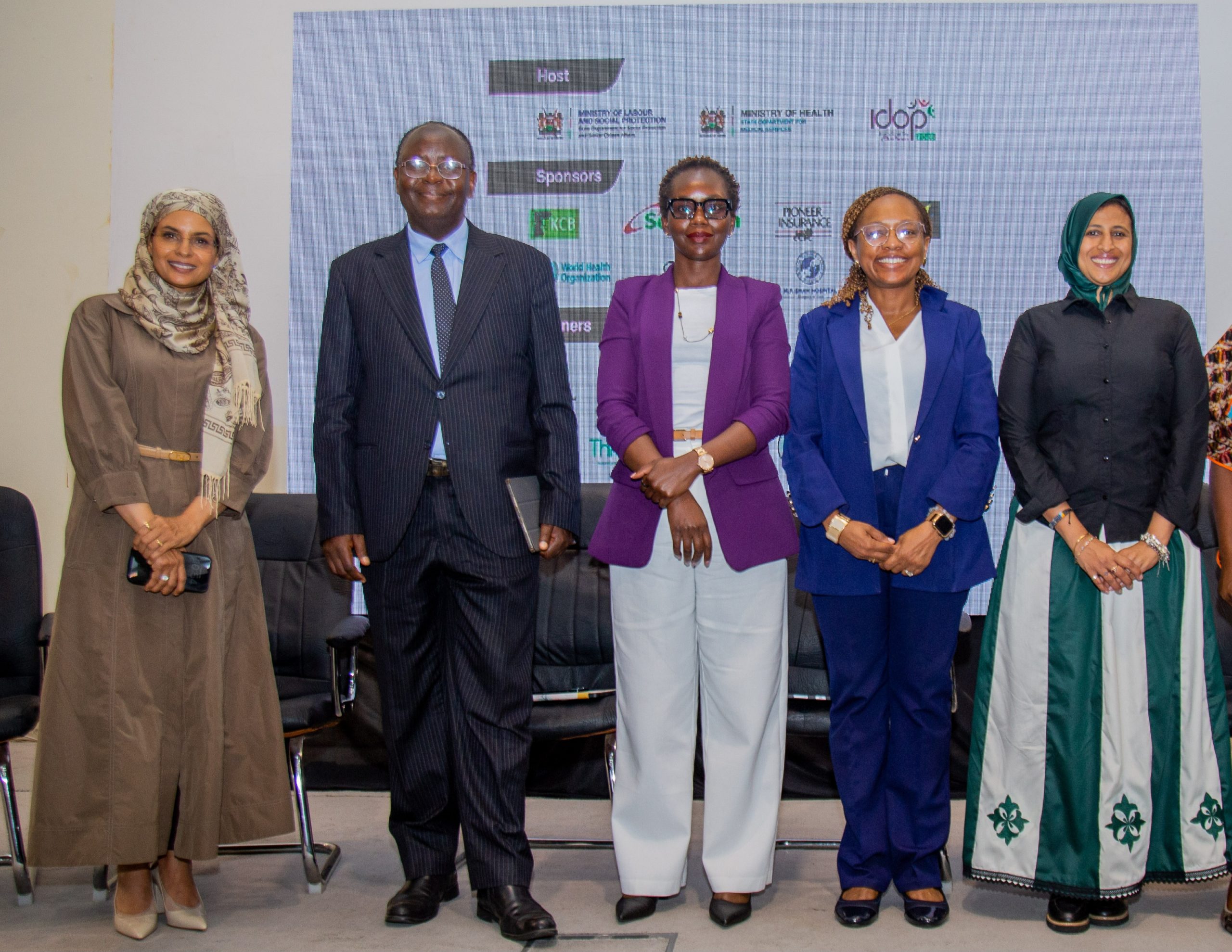
From left: Ms. Shakira Khawaja, Founder, Suqoon Kenya; Dr. Daniel Nyamongo, JKUAT Centre for Healthy Ageing; Dr. Rita Arogo, World Health Organization (WHO); Prof. Marianne Mureithi; and Dr. Tasneem Yamani, Hamat Health Hospital and Senior Advisor, Suqoon, during the International Day of Older Persons 2026 Scientific Pre-Conference at the Kenya Institute of Special Education (KISE), Nairobi, on September 30, 2026.
NAIROBI, September 30, 2026 (KNA) — Kenya has been urged to adopt a holistic approach to caring for older persons by strengthening health, social protection and community systems to respond to their changing needs.
Older persons often present with multiple health conditions and social challenges, requiring healthcare providers to look beyond individual illnesses and consider their overall wellbeing.
Speaking during the International Day of Older Persons (IDOP) 2026 Scientific Pre-Conference at the Kenya Institute of Special Education (KISE), Nairobi, geriatrician and healthy ageing expert Dr. Tasneem Yamani said older persons may live with several illnesses, take multiple medications and face challenges including limited mobility, financial difficulties and lack of access to healthcare.
“Older people come to you in a multiple, complex way. They have five diseases, ten medications, issues of being on their own, not being able to do things for themselves, having financial issues,” she said.
Yamani said geriatric care requires healthcare workers to assess the older person as a whole rather than focusing only on individual illnesses.
“You are not treating a disease in geriatrics. You are treating an old person,” she said.
She explained that geriatric care is guided by five key areas known as the “5Ms”: mind, mobility, medications, multicomplexity and what matters most to the individual.
On mobility, Yamani said healthcare providers should establish whether an older person can move independently and identify challenges such as pain, stiffness and weakness.
“Because the minute you stop being mobile, you will find yourself in places, exaggerating pre-existing illnesses, or creating new illnesses,” she said.
She also cautioned against automatically adding medication whenever an older person develops a new complaint, saying healthcare providers should review existing medicines and consider possible side effects and interactions before prescribing additional drugs.
Yamani further urged healthcare workers to consider an older person’s social circumstances, including whether they live alone, face financial difficulties, can access healthcare and are able to manage daily activities.
She said older persons should also be allowed to participate in decisions concerning their healthcare and have their preferences reflected in their care plans.
“If you’re able to speak for yourself, what you want for yourself is very important in every decision, including your health care,” she said.
Turning to the importance of data in planning for an ageing population, Dr. Rita Arogo of the World Health Organization said accurate information on older persons was essential for developing appropriate services and preparing systems for longer lives.
“To rethink systems, we need to think of the data first. Because if we do not count older persons appropriately, then we will not be able to take care of them,” she said.
The 2019 Kenya Population and Housing Census recorded about 2.7 million people aged 60 years and above.
Dr. Lydia Atambo Chair of the IDOP 2026 Conference Organising Committee and Director of the Africa Center of Excellence for Healthy Ageing and Older Persons, said the country should move beyond celebrating older persons and examine whether existing communities, systems and frameworks adequately respond to their needs.
“Beyond the celebration, we are asking whether the communities, systems and frameworks we have in place actually respond to their needs,” she said.
Founder of Suqoon Kenya Shakira Khawaja said the increasing number of people living longer should prompt the country to prepare for the needs associated with ageing.
“The International Day for Older Persons is an opportunity for us to think about older persons and to celebrate older persons. The theme this year is longevity and reframing longevity. But for me, the question is: we celebrate longevity, but are we ready for what it means in our country? We need to prepare ourselves for that,” she said.
The Scientific Pre-Conference is addressing a range of issues affecting older persons, including non-communicable diseases, cognitive decline, mental health, infectious diseases, elder abuse, nutrition, frailty, mobility, social connection, sexual and reproductive health, ethics, human rights and social protection.
The recommendations from the pre-conference will feed into the wider IDOP 2026 discussions and conference communiqué, with emphasis on practical measures to strengthen healthcare, policy and support systems for older persons.