Government Rolls Out Nationwide Verification for NYOTA Youth Empowerment Project
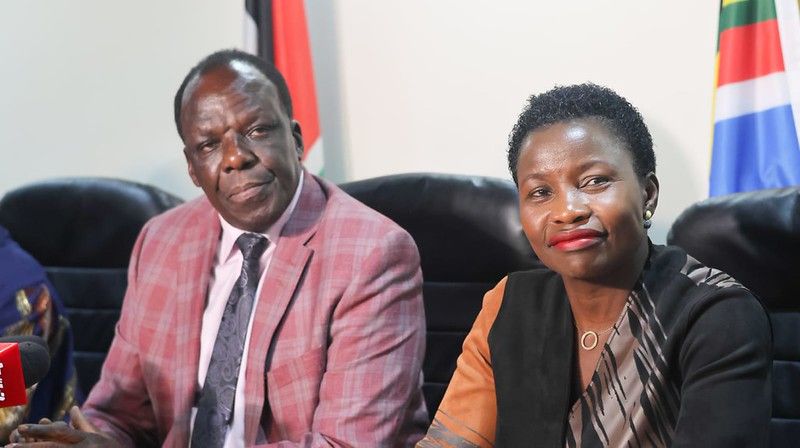
Cabinet Secretary for Cooperatives and MSMEs Development, Hon. FCPA Dr. Wycliffe Oparanya (left)Susan Mang’eni, the Principal Secretary State Department of MSME Development under the Ministry of Cooperative and MSME (right) addressing the press on Thursday 23rd,October 2025 in Nairobi.
The Government has launched a nationwide verification exercise for youth shortlisted under the National Youth Opportunities Towards Advancement (NYOTA) project, a flagship initiative aimed at empowering young Kenyans through entrepreneurship, mentorship, and inclusive economic opportunities.
The five-year programme, funded by the World Bank, seeks to transform the lives of vulnerable youth by promoting self-employment, financial inclusion, and innovation through practical business support and training.
Speaking during the announcement of the Physical Validation Exercise, Cabinet Secretary for Youth Affairs, Hon. Dr. Wycliffe Oparanya, said the exercise marks a critical milestone in the government’s efforts to equip young people with entrepreneurial tools for sustainable livelihoods.
“The NYOTA project is about transforming potential into enterprise. It gives young Kenyans a real opportunity to start and grow businesses, create jobs, and contribute to our country’s economy,” said Dr. Oparanya.
He noted that under the Business Support Component, 100,000 youth entrepreneurs will each receive KSh 50,000 start-up grants, training, and mentorship to help them launch and expand their businesses. “This verification exercise will ensure that only genuine and eligible youth are selected to benefit from the programme,” he added.
The CS said the physical validation will be conducted on Friday, October 24, 2025, across all 290 constituency headquarters, led by Principal Secretaries, elected leaders, National Government Administrative Officers (NGAOs), and the NYOTA Implementation Team.
“The government is using a whole-of-government approach to guarantee transparency, accountability, and efficiency in the process,” he stated.
Dr. Oparanya urged all shortlisted applicants to attend the exercise with their National Identity Cards, while Persons with Disabilities must also carry their disability identification cards for authentication.
“Only those who appear physically will be eligible for final selection. There will be no repeat exercise,” he cautioned.
He further noted that the Entrepreneurship Aptitude Test (EAT) remains a mandatory requirement for selection into the Business Support component. Applicants who have not yet taken the test will be allowed to do so on-site during validation.
“The test is free of charge, available in multiple languages, and can be done on any mobile phone by sending the word NYOTA to 40270,” he explained.
Principal Secretary for the State Department for Micro, Small and Medium Enterprises (MSME) Development, Susan Auma Mang’eni, said the NYOTA Project is designed to identify, train, and nurture local entrepreneurs across the country through structured mentorship and business development support.
“The Entrepreneurship Aptitude Test helps us assess the business intention and mindset of applicants. We are establishing a database, including those who are overqualified from colleges and tertiary institutions, so that we can design targeted initiatives to support them,” she said.
She explained that entrepreneurship is localized and that the programme will train and mentor youth within their communities to identify viable business opportunities.
“Every region has its own potential. That is why we are training people in their localities, using local trainers and mentors who understand the value chains in their environment,” she added.
The PS clarified that the process is transparent and applicant-driven. “This is one project where applicants applied for themselves. Everything was done online, even through simple feature phones, to make it accessible to all,” she said.
On whether youth with Hustler Fund loans would be disqualified, Mang’eni said that is not true. “Creditworthiness is encouraged as a good business attribute, but it is not a qualification criterion. We are nurturing responsible entrepreneurs who appreciate the importance of paying debts,” she explained.
She added that mentorship will continue for up to four months after training, with successful entrepreneurs receiving guidance from experienced business leaders.
“We want them to grow steadily, be visible in their communities, and become part of Kenya’s entrepreneurial success story,” she said.
The NYOTA Project targets 820,000 youth aged 18–29, and up to 35 years for Persons with Disabilities, across all 1,450 wards in Kenya. It focuses on enhancing employability, supporting entrepreneurship, and promoting savings through four key pillars: Recognition of Prior Learning (RPL), On-Job Experience (OJE), Business Support, and Digital Training on Access to Government Procurement Opportunities (AGPO).