

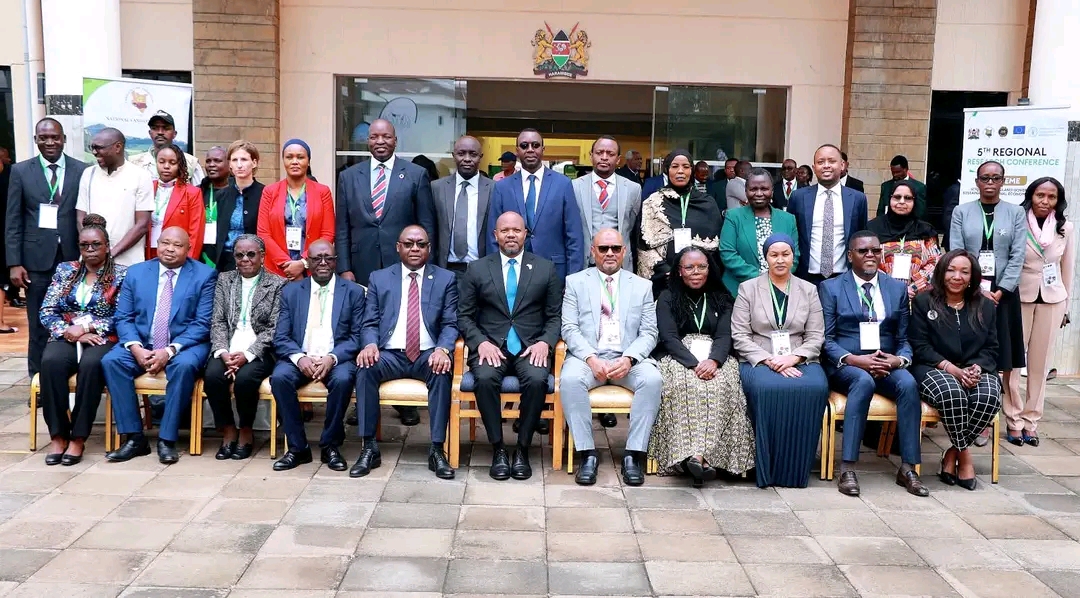
Photo Caption:Stakeholders pose for a group photo during the fifth Regional Research Conference on Land Governance held in Nairobi on Wednesday, August 19, 2026.
NAIROBI, August 19, 2026 — Stakeholders in the land sector have called for the speedy conclusion of the ongoing review of the National Land Policy to address emerging socio-economic, environmental, technological and institutional challenges facing the country.
The call was made during the fifth Regional Research Conference on Land Governance in Nairobi, which brought together policymakers, researchers, scholars, practitioners, development partners and private-sector representatives to share knowledge and experiences on emerging issues in land governance and sustainable land management.
Speaking during the conference, Kenya Vision 2030 Delivery Board Chairman and Chief Guest Dr. Emmanuel Kombe Nzai said the ongoing review of the National Land Policy was a welcome development but needed to be expedited to respond to the changing national landscape.
“There is a need to expedite the review process and conclude it within the shortest possible time,” Nzai said.
Nzai said land remained the basis of Kenya’s socio-economic development, noting that the manner in which it was governed had direct implications for economic prosperity, social protection and national development.>
“I urge all of you to engage in open, constructive and evidence-based discussions on the challenges we have highlighted, and to come forward with practical and actionable recommendations,” he said.
He commended the National Land Commission (NLC) for sustaining the regional research conference, saying stronger collaboration among Government, academia, researchers and industry would help generate practical solutions to land-related challenges.
FAO Representative in Kenya Ms. Farayi Constance Zimudzi said secure and equitable land rights were critical to encouraging investment, increasing productivity, improving access to finance, reducing conflicts and strengthening resilience against economic and climate shocks.
Farayi said sustainable land governance should recognise the rights and interests of pastoralist communities while promoting women’s access to land and productive resources.
“Sustainable land governance is inseparable from women’s economic empowerment and equal access to land and productive resources,” she said.
She noted that rapid urbanisation, infrastructure development, population growth, climate change, environmental degradation and competing land uses were putting increasing pressure on land resources, requiring more inclusive and sustainable approaches to land management.
“How we govern land determines not only how we grow our economies, but also how we protect livelihoods, manage natural resources and secure opportunities for future generations,” Farayi said.
Farayi said FAO was working with the Government, NLC, county governments and other partners to strengthen land information systems, address historical land injustices, support policy and legal frameworks, improve natural resource governance and promote evidence-based research.
NLC Chairperson Dr. Abdillahi Saggaf Alawy said land was a critical factor of production and the foundation for major activities including infrastructure development, housing, industrialisation, energy production and urban development.
Alawy said the Commission had facilitated compulsory land acquisition for strategic national projects in transport, water and sanitation, energy and security, while also undertaking measures to safeguard acquired land against encroachment.
“The Commission shall continue promoting effective and sustainable land governance that supports national socio-economic development,” Alawy said.
He said more than 25 counties had made progress in preparing their spatial plans and commencing implementation, while the Commission continued to provide oversight of land-use planning to promote orderly development and protect agricultural and environmentally sensitive areas.
Alawy said the Commission had also initiated efforts to help public institutions, including schools, secure title deeds for the land they occupy, noting that secure tenure would protect institutional land from encroachment and support development.
“A title deed is worth for a school; it is money in the bank, school loans and the rest of what our institutions need,” he said.
Representing Governor Johnson Sakaja, Nairobi Deputy Governor Dr. James Njoroge Muchiri said effective land governance was particularly important for the capital because of pressure arising from population growth, housing demand, infrastructure development, environmental concerns and competing land uses.
Muchiri said Nairobi could not expand beyond its existing geographical boundaries and therefore had to maximise the use of available land through proper planning, redevelopment and partnerships.
“We cannot solve Nairobi’s housing problem by pushing the city further out. We must use the land we already have, and that is why we are developing county assets through joint ventures and bringing in private capital and expertise,” Muchiri said.
He said the county was developing public assets through partnerships while seeking to ensure that redevelopment did not result in unfair displacement of residents and that new developments were supported by essential services such as water, sanitation, schools, transport and health facilities.
Muchiri said Nairobi was also moving from paper-based land records to digital processes to improve transparency and provide reliable information for planning, infrastructure development and protection of public assets.
“Our digital system in Nairobi has established a complete inventory of what belongs to the people of Nairobi. That information is how we will plan roads, housing, schools and protect public assets,” he said.
He said parks, road reserves, schools, markets and other public spaces should not be regarded as surplus land, noting that such spaces were essential to the functioning and development of the city.
“Once public land is lost, it is almost impossible to recover,” Muchiri said.
He urged researchers to provide evidence that could help governments improve policies and called for stronger partnerships among national and county governments, academia, the private sector, communities and development partners.
The two-day conference is expected to generate evidence-based and practical recommendations on land-use planning, land rights, public land management, compensation, digital land governance and unlocking land for strategic investments and sustainable economic development.