
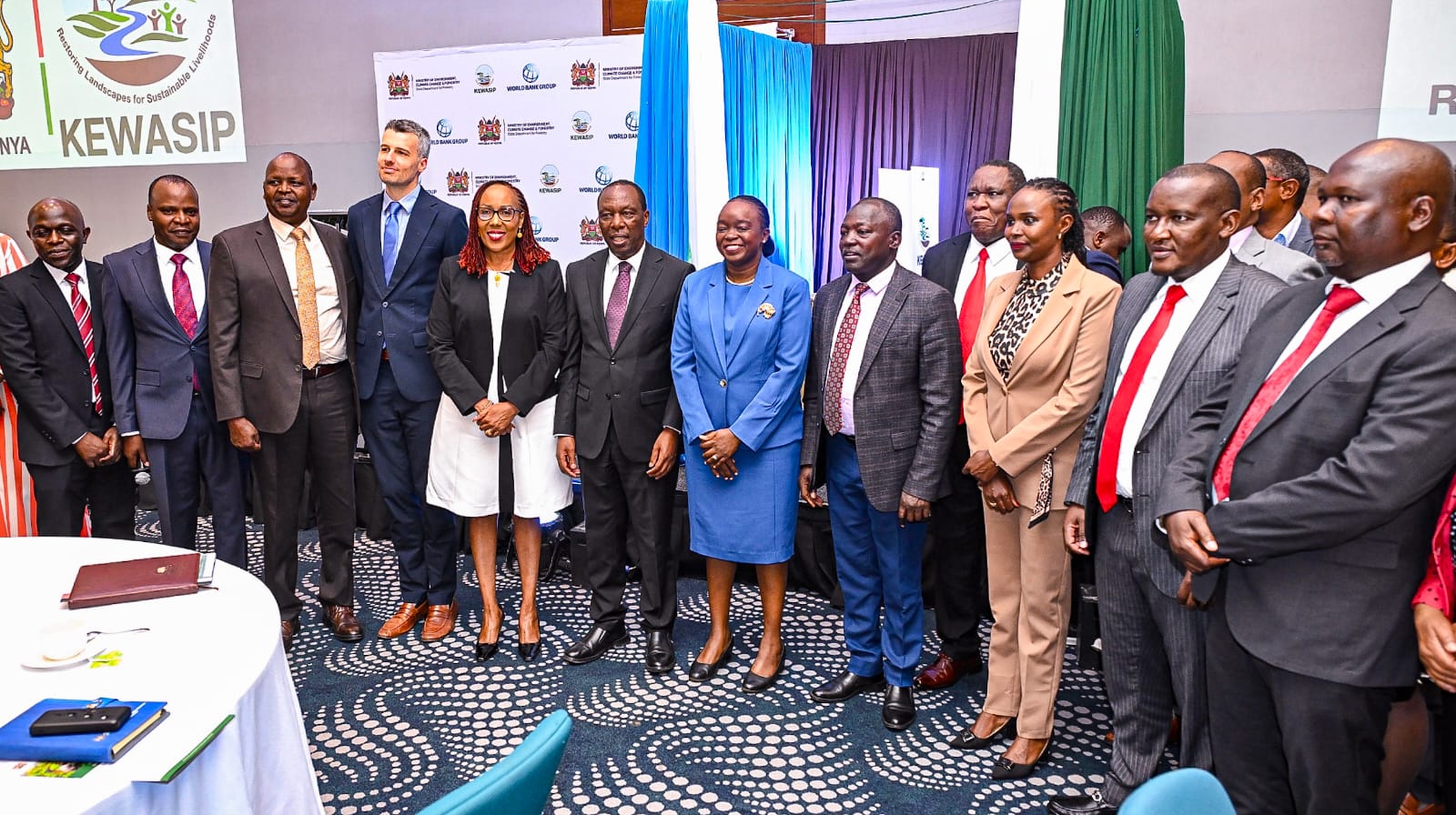
Photo Caption: Cabinet Secretary for Environment, Climate Change and Forestry Dr Deborah Barasa (centre, in blue) poses for a group photo with government officials, county representatives and World Bank representatives during the launch of the Kenya Watershed Services Improvement Project (KEWASIP) in Nairobi on November 2, 2026.
NAIROBI, November 2, 2026 – Kenya has launched a five-year US$200 million (approximately KSh25.8 billion) project targeting the restoration of degraded landscapes, protection of critical water catchments and improvement of community livelihoods in 12 counties.
The Kenya Watershed Services Improvement Project (KEWASIP), financed by the World Bank, seeks to expand sustainable land and watershed management, strengthen climate resilience and create economic opportunities for communities.
Speaking during the launch in Nairobi, Cabinet Secretary for Environment, Climate Change and Forestry Dr Deborah Barasa said the initiative would accelerate the country’s landscape restoration agenda while addressing environmental degradation and its economic consequences.
“Environmental degradation is therefore not merely a conservation concern; it is an economic and development challenge,” she said.
Barasa said the project would complement the Government’s 15 Billion Tree Growing Programme, which targets 30 percent national tree cover by 2032, and the National Landscape and Ecosystem Restoration Strategy 2025–2032, which provides a framework for restoring 10.6 million hectares of degraded landscapes.
She highlighted progress in the national restoration programme, including the planting of more than three million trees during the recent Mazingira Day activities and the establishment of 91 million mangroves along the Coast.
“Kenya is going green. We continue to restore,” she said, adding that indigenous forests account for 95 percent of forest cover, while commercial plantations account for five percent.
The CS said KEWASIP was expected to support the planting and nurturing of more than 240 million trees over five years, create over 25,000 jobs and benefit more than one million Kenyans through restoration activities.
“Restoration must go beyond tree planting. It must address the underlying causes of degradation, improve land management, protect biodiversity and create sustainable economic opportunities for communities,” she said.
On the project’s implementation, Principal Secretary for the State Department for Irrigation CPA Ephantus Kimotho said his department would support the initiative through the identification and development of water-harvesting infrastructure, including dams and water pans in targeted watersheds.
“In Marsabit, we are doing one of the biggest water pans ever constructed, with a capacity of around 750,000 cubic metres,” he said.
Kimotho said the infrastructure would improve water availability and support livestock production through the establishment of feedlots, helping pastoral communities cope with drought.
He called on implementing agencies to build on existing water infrastructure, noting that
“we also need to build a watershed and help with a little bit of upstream restoration” to complement ongoing water development projects.
Meanwhile, Principal Secretary for the State Department for Wildlife Silvia Museiya Kihoro said her department supported the project following extensive consultations that ensured the selected landscapes and interventions addressed national environmental priorities.
“If there are not enough forests and watersheds, then there is no wildlife for this country,” she said, emphasising the connection between ecosystem conservation, wildlife protection and tourism.
At the county level, Council of Governors Chief Executive Officer Mary Mwiti underscored the importance of devolved governments in ensuring the project’s success, given their responsibility for implementing natural resource management interventions.
“County Governments are central to the success of this program,” she said, reaffirming the counties’ role in supporting the initiative.
KEWASIP will be implemented across five priority landscapes namely Marsabit Hills, Marmanet Hills, Nyambene Hills, Chyulu Hills and Shimba Hills, covering Baringo, Meru, Kitui, Tharaka Nithi, Samburu, Isiolo, Marsabit, Makueni, Garissa, Kwale, Tana River and Laikipia counties.
The initiative will bring together national implementing institutions and county governments to strengthen natural resource governance, restore degraded ecosystems, protect biodiversity and improve water security and community livelihoods.