Hackathon Winners Crowned at Kenya Software & AI Summit as Youth Innovation Drives Digital Transformation
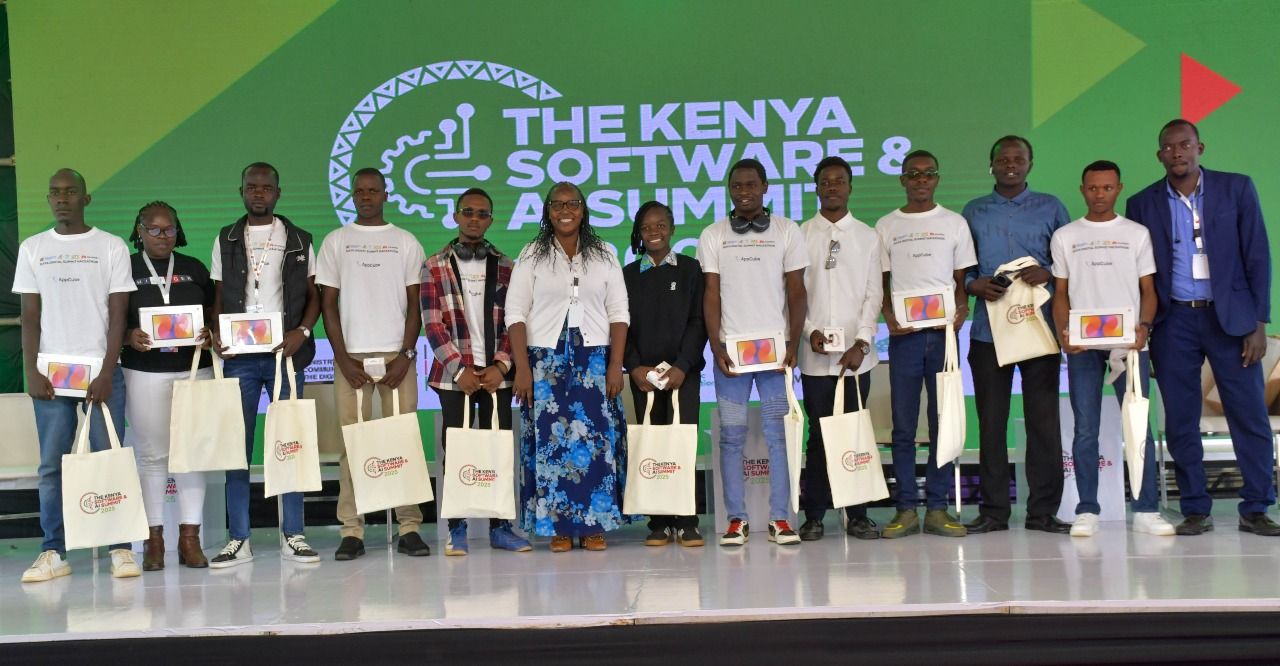
Youth-led teams from the Siaya Hackathon pose with leaders after being crowned winners at the Kenya Software and AI Summit held in Eldoret on November 12, 2025.
Three youth-led teams from Siaya County have emerged winners at the Kenya Software and Artificial Intelligence (AI) Summit held at Moi University Annex Campus in Eldoret, reaffirming Kenya’s strong commitment to nurturing homegrown digital talent and innovation.
The national competition, organized under the Jitume Digital Program, was spearheaded by Konza Technopolis in partnership with the Ministry of ICT and the Digital Economy and Huawei Kenya. The initiative aimed to empower young innovators to design digital solutions that address practical challenges faced by small and medium enterprises (SMEs) across the country.
Speaking during the event, Konza Technopolis Chief Executive Officer John Paul Okwiri said the hackathon demonstrated how grassroots innovation and digital skilling can transform communities and strengthen Kenya’s digital economy.
“Our national digital skilling programs are not just about creating jobs; they are about preparing youth to become creators of global digital value . The Jitume Digital Hubs are crucial decentralized nodes of the Silicon Savannah that enable communities to build innovation locally.” said Okwiri.
Okwiri noted that the success of the Siaya Hackathon was evidence of Kenya’s growing capacity to harness innovation for inclusive development.
“What we are witnessing here is the power of collaboration between government, industry, and the youth, through such partnerships, we are building an innovation pipeline that connects every region to Kenya’s digital transformation agenda.”he added.
He further emphasized that the event was a clear demonstration of how policy, mentorship, and technology can work together to transform ideas into viable solutions.
“We are investing in these digital hubs so that young people can transform their creativity into products that serve real market needs . This model is the foundation of Kenya’s future digital economy.” He said.
The 72-hour hackathon, held from October 13 to 15 at the Siaya Community Digital Hub, brought together 35 participants drawn from local institutions, including Bondo Technical Training Institute (TTI) and Jaramogi Oginga Odinga University of Science and Technology (JOOUST). The participants developed digital prototypes to solve issues such as limited market access, weak inventory systems, and lack of reliable digital payment tools for small businesses.
Huawei Kenya ICT Academy Manager Michael Kamau commended the initiative, describing it as a perfect example of how collaboration and mentorship can unlock the potential of rural innovators.
“The Siaya Hackathon proves that digital prosperity should not be confined to Nairobi . These three winning teams are the newest stars in our national innovation ecosystem.” Kamau said.
Kamau said Huawei’s contribution through the AppCube low-code platform allowed participants to turn their ideas into working prototypes in record time, with expert guidance from industry professionals.
“Our role as a technology partner is to empower local innovators with the tools and mentorship they need to bring their visions to life, this approach ensures that innovation reaches every county, every hub, and every youth.” He said.
He added that the hackathon aligns with Huawei’s broader mission of supporting Kenya’s digital transformation agenda through education, training, and partnership.
“We believe that Kenya’s youth are the foundation of Africa’s next digital economy. By supporting them with platforms like AppCube and mentorship programs, we are helping build a generation that can innovate globally while solving local challenges.” Kamau emphasized.
The top prize went to the DigitalNest Team, made up of Hesbon Otieno, David Tonje Wanambisi, Stephen Omondi, Derrick Omwanza, Lorrent Odhiambo, and Grace Oginga, who developed AGRILINK BONDO—a digital agricultural marketplace that connects farmers, buyers, and financial institutions to promote transparency, market access, and financial inclusion.
The Sentry Team took second place with Dhibiti Stock, a smart business management system helping MSMEs handle inventory, sales, and financial tracking more efficiently. The team comprised Blessed Kamungu, Michael Sule, Wycliff Opella, Faith Adhiambo, Dennis Chacha, Esther Lorah Adhiambo, and Jevan Otieno.
In third place was the Solutech Team, consisting of Dave Ochieng, Lewis Kinoti, Mathew Otieno, Winfresha Sarah, Rebeca Achieng, Oliver Ohana, and Dennis Naktare, who created Kazi-hub, a platform linking informal job seekers to local employers while offering digital training opportunities.
The hackathon’s success proved that youth-led creativity, supported by strong partnerships, can significantly contribute to national development and employment creation.