Kenya, Uganda and South Sudan Push for Joint SGR Expansion to Boost Regional Trade
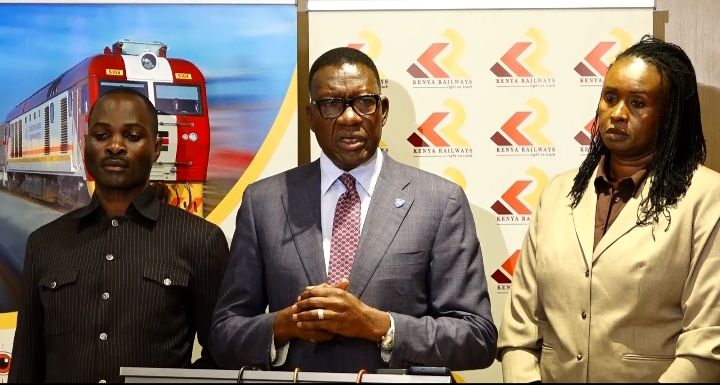
Cabinet Secretary for Roads and Transport Davis Chirchir (centre) with South Sudan’s Luol Deng Foundation CEO Arek A. Deng (right) and Uganda’s State Minister for Transport Fred Byamukama (left) during a joint briefing in Nairobi on the coordinated Standard Gauge Railway expansion along the Northern Corridor.
Kenya has renewed its commitment to fast-track the construction of the Standard Gauge Railway (SGR) from Naivasha to Kisumu and onward to Malaba in partnership with Uganda and South Sudan. The development is part of a regional effort to strengthen the Northern Corridor and ease the movement of cargo from the Port of Mombasa to neighbouring states and the Democratic Republic of Congo (DRC).
The Cabinet Secretary for Roads and Transport, David Chirchir, hosted Uganda’s State Minister for Transport, Fred Byamukama, and a representative from South Sudan in Nairobi for consultations on financing, cargo projections and technical readiness for simultaneous construction.
Speaking during the briefing, CS Chirchir said Kenya was ready to begin works on the 262-kilometre Naivasha–Kisumu section and the 107-kilometre Kisumu–Malaba stretch.
“We are seeking to break ground in the shortest time possible to accelerate the development of this infrastructure,” he said.
Chirchir noted that the SGR will help decongest roads and improve cargo efficiency.
“This month, Kenya moved 640 million tonnes of cargo by rail, up from an average of 500 million tonnes, and we must expand capacity to support regional demand,” he said.
He stated that the government will rely on the Railway Development Levy Fund (RDLF) and external financing to complete the project.
“We collect about Sh40 billion annually from the RDLF, and this gives us a strong foundation to leverage support from development partners,” he said.
Chirchir added that the three countries must move together to ensure effective connectivity.
“We cannot have Uganda completing their section while Kenya delays, because this is a shared corridor that must operate as one network,” he said.
He also highlighted the proposed reform under the draft Railway Bill to open the SGR for private operators.
“The bill seeks to separate infrastructure from operations so that private companies can run locomotives on the line and pay a toll,” he said.
Speaking during the same briefing, Uganda’s State Minister for Transport Fred Byamukama said East Africa must shift bulk cargo from roads to rail to cut costs.
“Our countries spend too much repairing roads because trucks carry most of the cargo instead of rail,” he said.
Byamukama said cheaper transport will translate to cheaper goods for citizens across the region. “If cargo moves by rail, the cost of commodities will reduce and benefit our people,” he said.
He confirmed that the three governments have given technical teams nine weeks to verify cargo data. “We want accurate figures to confirm the business case for the railway,” he said.
Byamukama said Uganda supports Kenya’s plan to fast-track the Naivasha–Malaba route.
“We are constructing from Kampala to Malaba, and we are happy Kenya is moving quickly so that the corridor develops together,” he said.
He also addressed the importance of accurate cargo projections in securing financing.
“Railway investments rely heavily on future cargo volumes, and we are updating data to ensure the project is bankable,” he said.
He added that the government will engage lenders on long-term financing instruments suitable for large infrastructure.
“We are analysing different financial options to match the long-term nature of railway development,” he said.
The ministers agreed that the coordinated SGR expansion will cut freight delays, strengthen regional competitiveness and open new markets across East and Central Africa.
They reaffirmed their commitment to delivering a seamless corridor linking Mombasa, Nairobi, Naivasha, Kisumu, Malaba, Kampala, Gulu and Juba.