
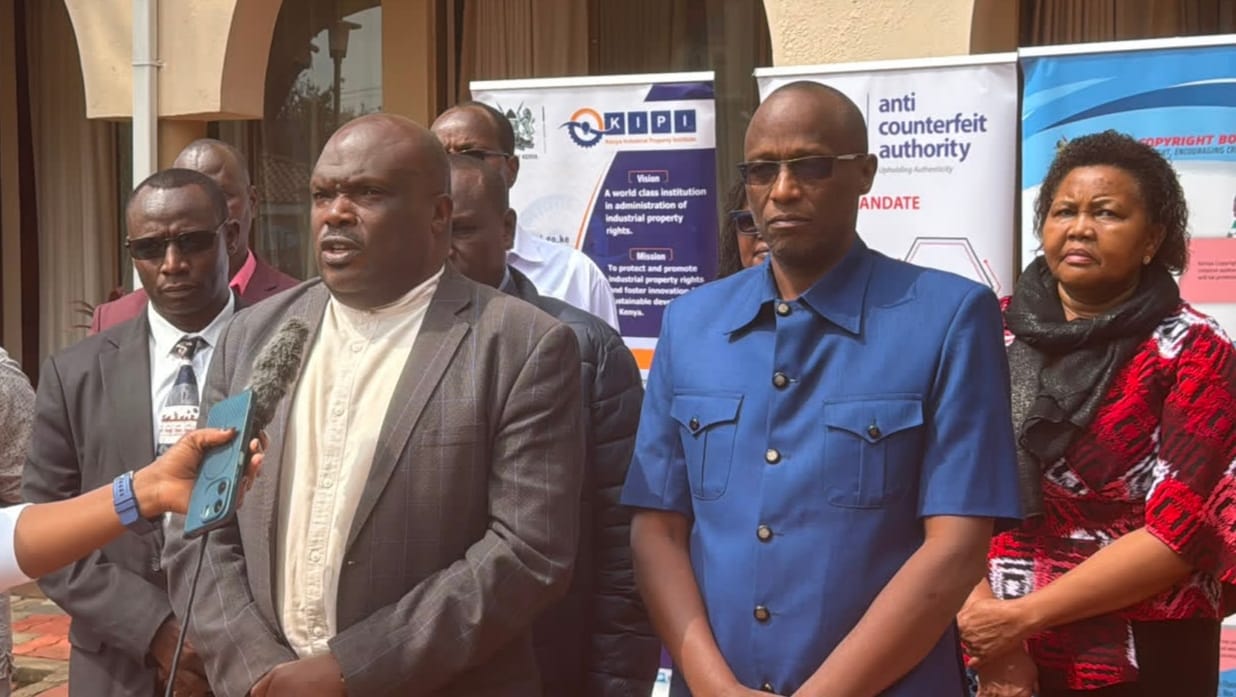
Anti-Counterfeit Authority Executive Director Dr. Robi King’a (centre) addresses the media during the National Intellectual Property Policy and Strategy (NIPPS) 2026 public participation forum in Nairobi. With him are Stephen Ng’eno (left), Deputy Managing Director for Technical Services at KIPI, and King’uru Wahome (right), Director of Industries representing the State Department for Industry.
Nairobi ,July 31, 2026 – Kenya has intensified efforts to safeguard innovation, creativity and indigenous knowledge through the development of its first-ever National Intellectual Property Policy and Strategy (NIPPS) 2026, with government agencies calling for public participation to ensure the framework reflects the aspirations of inventors, researchers, artists, entrepreneurs and local communities.
Speaking during a public participation forum at the Kenya Institute of Curriculum Development (KICD) in Nairobi on Friday, government officials and intellectual property experts said the proposed policy is expected to strengthen protection for innovations, stimulate industrialisation and position intellectual property (IP) as a key driver of economic transformation.
The forum, which brought together representatives from national and county governments, academia, research institutions, industry players, creators and the media, forms part of a nationwide consultative exercise aimed at gathering public views before the policy is submitted to Cabinet.
Representing the Principal Secretary for the State Department for Industry, King’uru Wahome, Director and Deputy Director of Industries, underscored the importance of protecting Kenya’s intellectual assets, describing them as critical resources capable of accelerating economic growth and preserving the country’s cultural identity.
He said Kenya possesses a rich heritage of traditional knowledge, cultural expressions and indigenous innovations that deserve the same level of protection enjoyed by globally recognised cultural assets.
Drawing comparisons with New Zealand’s internationally protected Haka dance, Wahome noted that Kenya’s diverse cultural expressions, music and indigenous traditions should equally be safeguarded from exploitation while generating value for communities.
He cited the globally recognised phrase “Hakuna Matata” as an example of a cultural expression with Kenyan roots that has attained international recognition, stressing the need for stronger mechanisms to protect such intellectual assets for the benefit of the country.
Beyond cultural heritage, Wahome challenged universities, research institutions and innovators to move beyond merely publishing research and instead focus on creating innovations that can be patented, commercialised and translated into tangible economic benefits.
“The question should no longer be how much research we publish, but how many innovations our researchers own, protect and commercialise,” he said.
He observed that although Kenyans are widely recognised for their creativity and innovative spirit, many locally developed inventions fail to generate maximum value because they are inadequately protected.
Using the globally acclaimed mobile money innovation M-Pesa as an example, Wahome argued that Kenya must strengthen intellectual property systems to ensure innovators fully benefit from their inventions while enhancing the country’s competitiveness in global markets.
He further linked intellectual property protection to President William Ruto’s industrialisation agenda, saying innovation, technology, manufacturing and agriculture remain central pillars of Kenya’s long-term economic ambitions.
According to Wahome, robust IP protection would stimulate knowledge-based economic growth, strengthen entrepreneurship, enhance competitive manufacturing, promote value addition in agriculture, preserve cultural heritage, attract investment and create employment opportunities.
He encouraged participants to contribute candidly during the consultations, assuring them that every proposal would be carefully reviewed before the policy is finalised.
Earlier, Stephen Ng’eno, Deputy Managing Director for Technical Services at the Kenya Industrial Property Institute (KIPI), who represented Managing Director John Onyango, described the forum as a significant milestone in Kenya’s intellectual property journey.
He noted that despite the country’s growing innovation ecosystem, Kenya has operated for decades without a comprehensive national intellectual property policy, creating gaps in coordination and protection.
Ng’eno said the rapid emergence of artificial intelligence, digital platforms and the expanding creative economy had made it necessary to establish a modern policy capable of responding to evolving technological and commercial realities.
He explained that the proposed policy covers the full spectrum of intellectual property, including patents, utility models, industrial designs, trademarks, trade secrets, geographical indications, copyright, plant breeders’ rights, traditional knowledge, genetic resources, folklore as well as AI-driven innovations.
He described the consultations as a listening exercise intended to gather practical recommendations from innovators, creators and the public on how IP services can become more accessible, affordable and commercially rewarding.
Among the key issues under discussion are strategies for enabling innovators and artists to earn sustainable incomes from their creations, strengthening enforcement against infringement, protecting traditional knowledge and ensuring communities benefit from their cultural resources.
Ng’eno assured stakeholders that all submissions would be considered before the final draft is presented to Cabinet, adding that the ultimate objective is to establish an intellectual property system that creates jobs, protects creators and contributes meaningfully to national economic growth.
“We want a policy that serves every county, every innovator and every Kenyan with an idea,” he said.
Also addressing the forum, Anti-Counterfeit Authority (ACA) Executive Director Dr. Robi King’a said the nationwide public engagement was anchored in constitutional requirements obligating the government to consult citizens before adopting major public policies.
He revealed that consultation teams had spent the week traversing different regions, including Garissa, the Coast, Embu, Nakuru, Eldoret and Western Kenya, collecting views from diverse stakeholders.
According to Dr. King’a, the proposed policy seeks to fulfil Article 40(5) of the Constitution, which obligates the State to promote, protect and support the intellectual property rights of the people of Kenya.
He said intellectual property has become an indispensable component of Kenya’s industrialisation agenda, particularly as the country seeks to expand its creative economy and encourage innovation among young people.
The ACA chief noted that agriculture also presents enormous untapped opportunities through value addition and protection of locally developed products, arguing that stronger intellectual property systems would help ensure Kenyan agricultural commodities generate greater returns instead of being exported largely as raw materials.
He observed that while Kenya already has laws governing various aspects of intellectual property, the absence of an overarching national policy has limited coordination among institutions responsible for implementation.
The proposed framework, he added, will align Kenya’s intellectual property ecosystem with the Constitution, Vision 2030, the Bottom-Up Economic Transformation Agenda, the African Union’s Agenda 2063 and the East African Community Vision 2050.
Officials expressed optimism that once adopted, the National Intellectual Property Policy and Strategy will provide a coherent roadmap for protecting creativity, encouraging innovation, supporting industrial development and ensuring Kenyan ideas, inventions and cultural heritage become valuable assets capable of driving sustainable economic growth.