
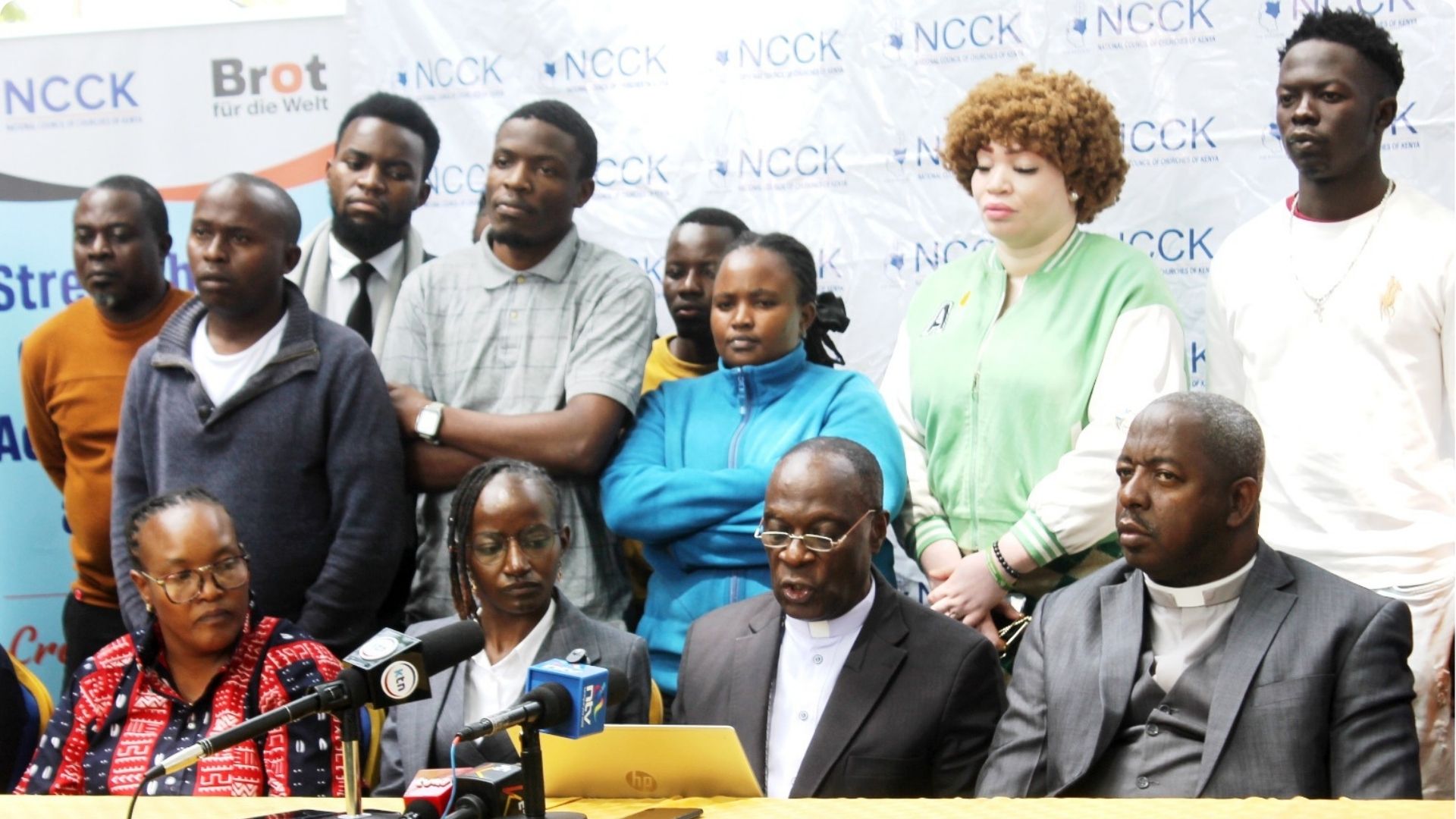
Front row, from left: Madam Florence, Rev. Jackline Makena, NCCK Chairperson Rev. Dr. Alphonse Kanga, and Rev. Canon Charles Chege, with other delegates from NCCK member churches during a press briefing in Nairobi.
NAIROBI, May 06, 2026 — The National Council of Churches of Kenya (NCCK) has called for accountability, institutional reforms and responsible leadership ahead of the 2027 General Election, warning that growing political intolerance, economic pressures and weak governance could undermine national cohesion and public confidence in key institutions.
The church organization also urged sustained collaboration among leaders, institutions and citizens to address emerging social, economic and governance challenges facing the country.
Speaking during a Nairobi Regional meeting held at the YMCA Central Conference Hall, NCCK General Secretary Rev. Dr. Alphonse Kanga expressed concern over the state of governance and the increasing disconnect between constitutional ideals and public leadership.
“We remain deeply concerned that the democratic ideals envisioned in the Constitution are being overshadowed by a transactional political culture that prioritises elite interests over the welfare of wananchi,” said Kanga.
Kanga noted that Kenya’s progress depends on adherence to constitutional principles, accountability and ethical public service. He warned that political intolerance and isolated incidents of violence witnessed during public engagements threaten democratic gains and peaceful coexistence.
He called on leaders and institutions charged with maintaining law and order to ensure that political activities are conducted within the law and with respect for human dignity.
“There is need for all stakeholders to ensure that political activity is conducted within the law, with respect for human dignity and peaceful coexistence,” he said.
The church leader further warned against hate speech and incitement, saying failure by institutions to act decisively would continue to weaken national unity and erode public trust.
Beyond governance concerns, Kanga highlighted challenges facing ordinary Kenyans, including rising food prices, recurring urban flooding and concerns surrounding the implementation of the Social Health Authority (SHA).
He called for greater transparency and efficiency in the management of public resources, particularly in the health sector, while urging the government to strengthen food security programmes and support vulnerable households struggling with the high cost of living.
“Health is a constitutional right, and systems must work efficiently to ensure citizens receive quality services,” Kanga said.
The NCCK also called for improved urban planning, investment in drainage infrastructure and stricter enforcement of environmental regulations to mitigate recurring flooding in major towns and cities.
On electoral preparedness, NCCK Nairobi Region Vice Chairperson Rev. Canon Charles Chege called for transparency and merit-based operations at the Independent Electoral and Boundaries Commission (IEBC), saying public confidence in the electoral body remains fragile despite the appointment of new commissioners.
“The NCCK insists on a transparent, merit-based operation of the Independent Electoral and Boundaries Commission to safeguard our democracy against the threat of state capture,” said Chege.
Chege called for accountability over alleged breaches involving the biometric voter database and demanded the reversal of involuntary voter transfers, arguing that public trust in electoral processes can only be restored through openness and adherence to the law.
He also criticized the growing trend of early political campaigns and urged the IEBC to strictly enforce electoral regulations to ensure a level playing field for all political actors.The council further announced measures aimed at preserving political neutrality within churches as the country moves closer to the election period.
Under the new guidelines, politicians will not be allowed to address congregants during worship services, while political donations will be treated as ordinary offerings without special recognition.
NCCK also directed clergy to remain nonpartisan and avoid actions that may compromise the church’s credibility as an independent moral voice.
“The church must remain a credible moral voice in society by promoting justice, accountability and human dignity while remaining independent of partisan political interests,” Chege said.
The council reaffirmed its commitment to peacebuilding, national dialogue and ethical leadership, pledging to continue engaging leaders, institutions and citizens in efforts aimed at strengthening democracy, promoting accountability and fostering national unity ahead of the 2027 General Election.