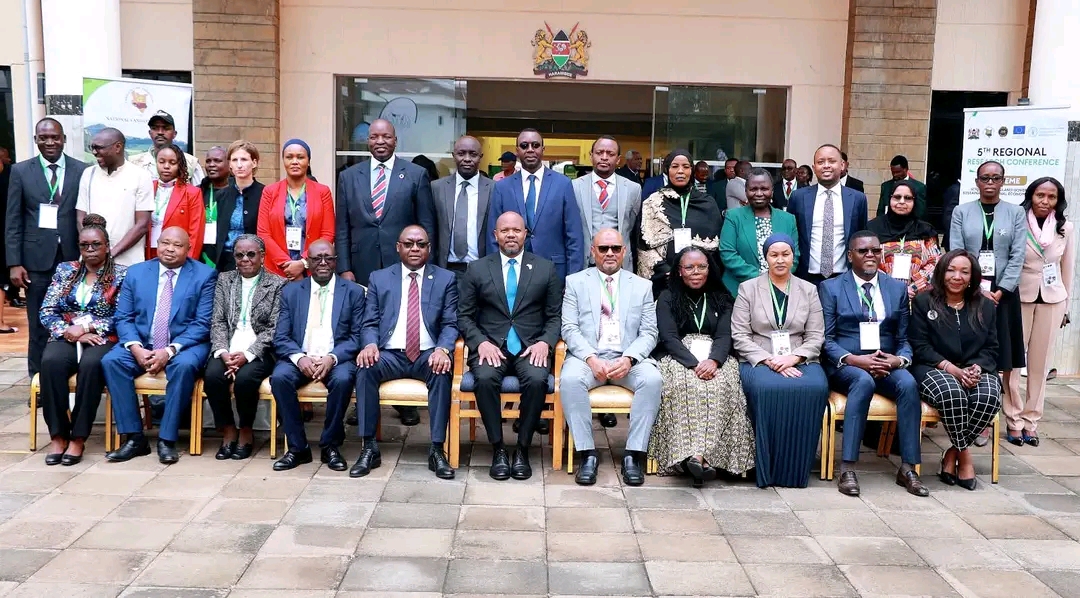


Photo Caption:NCCK General Secretary Rev. Canon Chris Kinyanjui (center) addresses media during the 4th National Youth Convening at CSLC-Ufungamano House on Friday, September 25, 2026.
NAIROBI, Kenya — Young people have called for greater and continuous participation in governance, policy development and decision-making, saying their role should go beyond being mobilised during elections.
The call was made during the 4th National Youth Convening held on Friday, September 25, 2026, at CSLC-Ufungamano House under the theme “Claiming Space, Shaping Kenya.” The gathering brought together young people and stakeholders to discuss governance, civic participation, livelihoods, technology and innovation.
Speaking during the convening, NCCK General Secretary Rev. Canon Chris Kinyanjui said young people should be recognised as citizens, innovators, entrepreneurs and active partners in shaping Kenya’s present and future.
He said the youth should have meaningful opportunities to participate in decision-making from the grassroots to the national level, including policy development, public participation, leadership and oversight.
“We envision a Kenya where governance is inclusive, accountable, transparent, responsive and citizen-centred.”He said.
Rev. Canon Kinyanjui also emphasised the importance of leadership that listens to citizens, upholds integrity and constitutional values, and remains accountable for decisions and the use of public resources.
He said young people also have a responsibility to remain informed and engaged in governance and to demand accountability.
“Meaningful governance requires citizens who are informed, engaged and willing to demand accountability.”He said.
The convening also called for peaceful, informed and issue-based political participation as Kenya approaches another electoral cycle, while rejecting misinformation, disinformation, political manipulation and ethnic mobilisation.
Claire Njagi, a youth peacebuilding advocate, said technology was increasingly becoming part of how young people live, learn, work, communicate and create opportunities.
She said digital technologies, social media, digital payments and artificial intelligence were creating new possibilities in entrepreneurship, employment, learning, markets and inclusion.
“Access to technology is not automatically access to opportunity.”She said.
Njagi said young people continued to face barriers including the cost of devices and internet access, unreliable power, limited digital skills, inadequate mentorship, lack of capital, certification challenges and limited access to markets and networks.
She also highlighted the need to help young people move from daily hustles to sustainable enterprises capable of growing and creating employment.
The communiqué identified challenges facing young enterprises, including cash flow, customer retention, competition, taxation, record keeping, registration, licensing and operational costs. It also called for greater access to mentorship, financing, partnerships and networks.
On artificial intelligence, the youth welcomed emerging technologies while stressing the importance of human judgment, creativity and responsibility.
They raised concerns about data privacy, digital safety, misinformation, errors in AI-generated information, child protection and over-reliance on technology, and called for young people to continuously develop their skills as technology evolves.
Njagi further said technology should help expand opportunities rather than deepen exclusion, with young people needing affordable digital infrastructure, skills development, financing, mentorship, networks and access to markets.
“We want technology to expand opportunity, not deepen exclusion.”She said.
The communiqué also highlighted unemployment, rising living costs, financial pressure, repeated rejection, relationship difficulties and social expectations as challenges affecting young people.It called for stronger support systems, safe spaces for honest conversations, appropriate professional care and livelihood approaches that address the whole person.
The youth called on the government, private sector, civil society, faith institutions, development partners and other stakeholders to invest in systems that can help young people turn their ideas and skills into sustainable opportunities.
They also called for collaboration across generations, combining the experience and knowledge of older generations with the energy, creativity and innovation of young people to address challenges facing communities.