

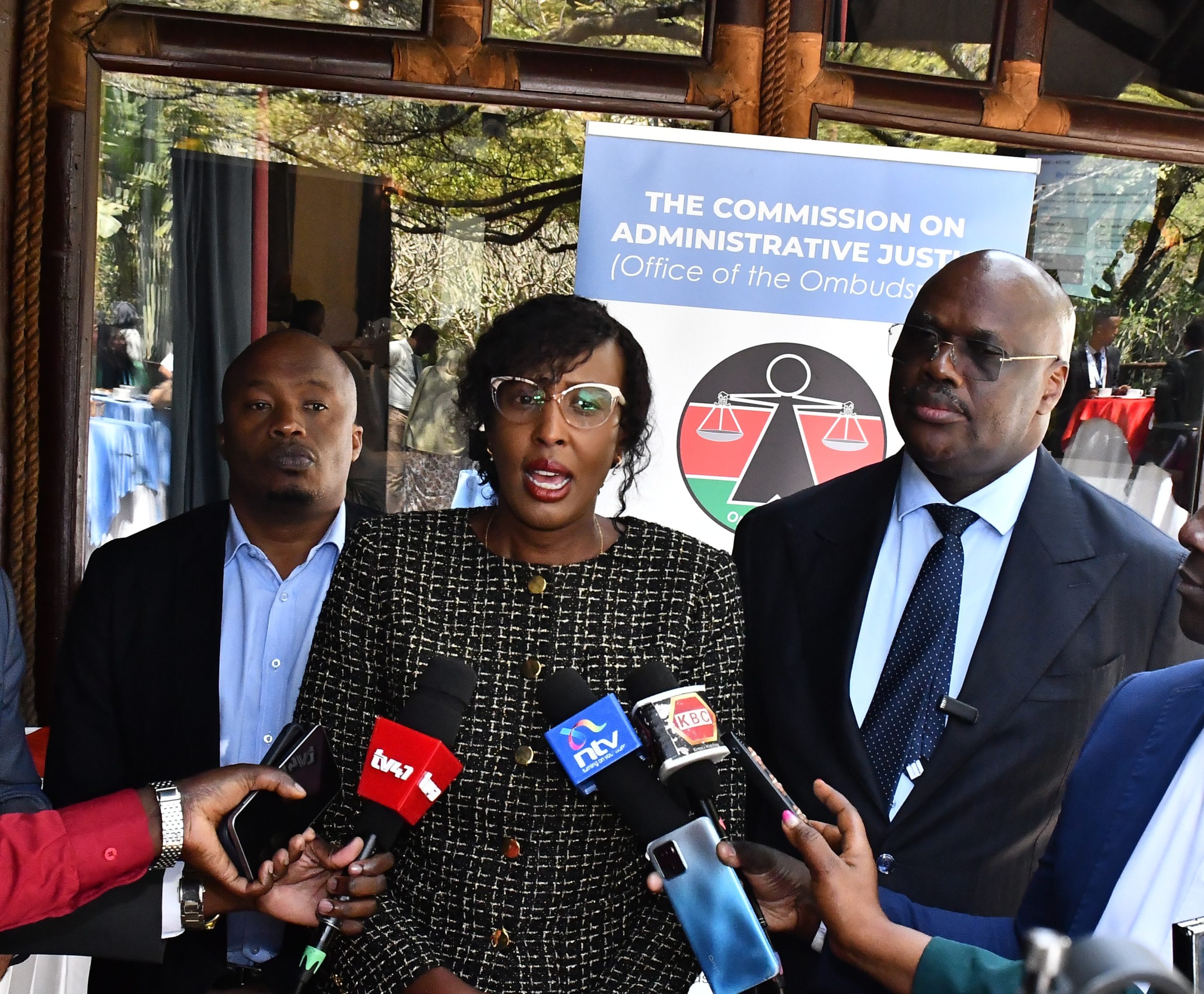
Photo Caption: From left, CAJ Commissioner in charge of Complaints and Investigations Charles Kanyi, Chairperson Charles Dulo and Vice-Chairperson and Commissioner in charge of Access to Information Dorothy Jemator during a consultative meeting with ministries, State departments and public institutions in Nairobi on August 25, 2026.
NAIROBI, August 25, 2026 — The Commission on Administrative Justice (CAJ) has called on public institutions to strengthen complaints resolution systems and improve compliance with the Access to Information Act, 2016, saying timely responses and proactive disclosure are essential to accountable and responsive public service delivery.
Speaking during briefing after high-level consultative meeting with ministries, State departments and public institutions in Nairobi, CAJ Chairperson Charles Dulo said administrative justice and access to information should be treated as core elements of good governance.
“Administrative justice and access to information are not peripheral compliance matters. They are central to lawful, responsive and trusted government,” Dulo said.
He said the Commission continued to encounter unanswered referrals, delayed feedback, fragmented responsibility, incomplete records and failure by some institutions to implement its recommendations, challenges that often resulted in avoidable escalation of disputes.
Dulo urged institutional leaders to treat complaints as management information that can expose weaknesses in policies, procedures and service delivery and provide opportunities to correct problems before they become systemic.
“A complaint is an early-warning signal. It can reveal a policy gap, an unclear procedure, a weak service standard, poor communication or a repeated exercise of discretion that produces unfair outcomes,” he said.
He said effective complaints management required clear institutional ownership, predictable referral and feedback arrangements, evidence-based implementation of recommendations and regular reporting to boards and senior management.
Vice-Chairperson and Commissioner in charge of Access to Information Dorothy Jemator said the meeting was addressing both proactive and reactive disclosure, with institutions expected to make information of public interest readily accessible.
“Information that every Kenyan should have easy access to should be proactively disclosed and that’s what we are telling them to do,” Jemator said.
She said institutions were also being equipped with knowledge on responding to requests for information, particularly academic transcripts, degree certificates, examination results and other records sought by students.
Jemator said the Commission had encountered cases where Kenyans struggled to correct academic records or obtain information they were entitled to access, urging those facing such challenges to seek assistance from the Ombudsman.
The Commission recorded a sharp increase in applications for review, from 32 in the 2016/17 financial year to 654 in 2025/26, representing more than a 20-fold increase.It received 2,260 applications over the 10-year period.
Commissioner in charge of Complaints and Investigations Charles Kanyi said the engagement was intended to help government officers address complaints at institutional level and identify their root causes.
He said complaints reaching the Commission often indicated that an issue had already been raised with a public institution but had not been satisfactorily resolved, making it necessary to strengthen internal mechanisms.
“When a complaint reaches us, it shows that there are issues that have not been resolved at the institutional level,” Kanyi said.
The Commission received 813 complaints against public institutions between January and December 2025, with 228, representing 28 per cent, resolved and 579, or 72 per cent, pending at the end of the reporting period.
Nine institutions accounted for 630 complaints, equivalent to 77 per cent of the total.Delay was the leading complaint category among the nine high-volume institutions, accounting for 42 per cent of complaints, followed by unresponsive official conduct at 10 per cent, unfair treatment at nine per cent and inefficiency at seven per cent.
The three-day consultative meeting brings together leaders from 54 institutions, including nine State departments, to strengthen compliance with the law, streamline referral pathways, improve feedback mechanisms and reduce case backlogs.
The Commission has urged institutions to designate empowered Information Access Officers, establish clear procedures, respond within statutory timelines, strengthen records management and implement decisions arising from the access-to-information review process.