
SHA to Roll Out National Emergency Care Services in Two Months
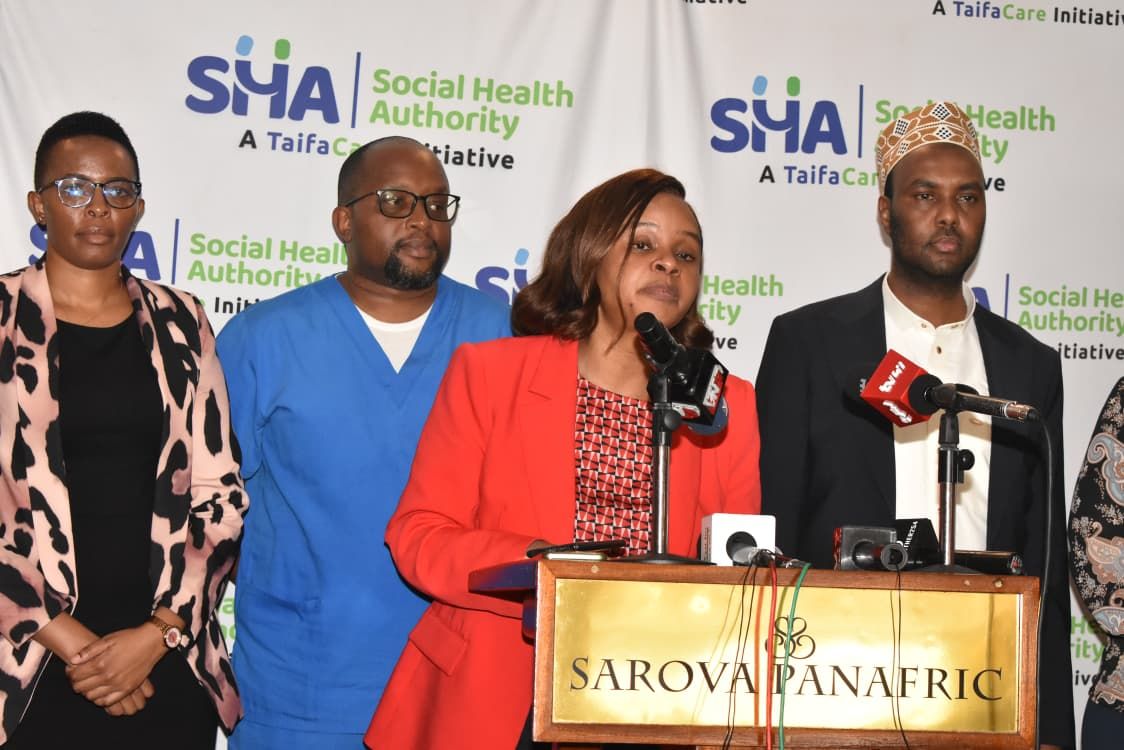
SHA Chief Executive Officer Dr. Mercy Mwangangi (center) addresses the press during a media briefing in Nairobi.
The Social Health Authority (SHA) will, in the next two months, launch a nationwide emergency care system that will guarantee every Kenyan free ambulance evacuation and treatment for the first 24 hours of a medical emergency.
The initiative is part of the government’s broader Universal Health Coverage (UHC) reforms and is expected to revolutionise how emergency cases are handled across the country. For the first time, Kenyans in both urban and remote areas will be assured of timely, life-saving interventions regardless of their financial or insurance status.
Speaking during the press SHA Chief Executive Officer, Dr. Mercy Mwangangi, said the programme, to be officially unveiled by President William Ruto, will ensure that all citizens whether registered or not can access their constitutional right to emergency care.
“Each and every Kenyan will soon be able to pick up the phone, dial a toll-free number, and report an emergency. SHA will then dispatch an ambulance to transfer the patient to the nearest emergency care centre,” Dr. Mwangangi said.
The system will be powered by a digitised electronic platform that can pinpoint a caller’s location, track the nearest available ambulance, and guide patients to the most suitable emergency facility. To sustain the service, SHA will reimburse ambulance providers at Sh4,500 for trips within 25 kilometres and at Sh75 per kilometre for longer distances.
Dr. Mwangangi clarified that the authority will also cater for the first 24 hours of hospital care. Thereafter, patients will continue treatment under the Social Health Insurance Fund (SHIF) or pay out of pocket if they are not registered.
“It is very important for Kenyans to understand that evacuation will be free, and the first 24 hours will be free. After that, one must either be a paid-up SHIF member or cover costs directly,” she said, noting that the service will also extend beyond road ambulances to include boats in water-reliant counties.
Only accredited and contracted ambulance service providers will be engaged to ensure quality of care. Callers will not be required to explain medical conditions in detail, as dispatchers are trained to categorise emergencies appropriately. However, she cautioned that the service will not cover routine appointments such as dialysis, stressing that strict protocols will prevent misuse.
Dr. Benjamin Wachira, Executive Director of the Emergency Medicine Kenya Foundation (EMKF), welcomed the initiative, describing it as a milestone that will transform healthcare delivery and reduce preventable deaths.
“For the first time, Kenya will have a public ambulance service operating nationwide, saving the lives of mothers in childbirth, accident victims, and patients who often die before reaching hospital,” Dr. Wachira said. He added that the programme, modelled on the World Health Organization’s Emergency Care System Framework, is designed to be sustainable, offering care from the community level, stabilising patients, and transporting them to fully equipped centres.
Health Economist Faith Tonkei explained SHA’s three financing mechanisms: the Primary Health Care Fund, which already supports 26 million Kenyans at lower-level facilities; the Social Health Insurance Fund (SHIF), a contributory scheme; and the Emergency, Chronic and Critical Illness Fund (ECCIF), which caters for emergency evacuation.
She emphasised that eligibility is universal and not dependent on registration. “Out-of-pocket care is expensive. That is why we encourage Kenyans to register and pay for SHIF to avoid financial hardship after stabilisation,” Tonkei said.
According to SHA officials, emergencies covered under the package will include life-threatening conditions such as cardiac arrest, strokes, severe bleeding, and pregnancy-related complications. Trained dispatchers will triage calls, give telephonic instructions, and determine whether an ambulance is necessary.
Tonkei added that SHA is partnering with both private and public ambulance providers to expand coverage, with all required to meet standards set by the Kenya Medical Practitioners and Dentists Council. She urged the media to boost public awareness, saying: “This benefit package is not just policy; it is a promise in motion. With your platforms, Kenyans will know that this lifeline exists.”
Dr. Mwangangi and Dr. Wachira both expressed optimism that the rollout will change the face of emergency care in Kenya.
“This is about saving lives and ensuring that no one dies simply because help was not available,” Dr. Mwangangi said. Dr. Wachira echoed her sentiments, calling it an exciting milestone that will require close collaboration with government and partners to succeed.
As Kenya prepares to roll out the service, health experts agree that the programme could mark a turning point in reducing avoidable deaths and strengthening trust in public healthcare. If fully embraced and sustained, the nationwide emergency care system could become one of the most impactful health reforms in the country’s history.