
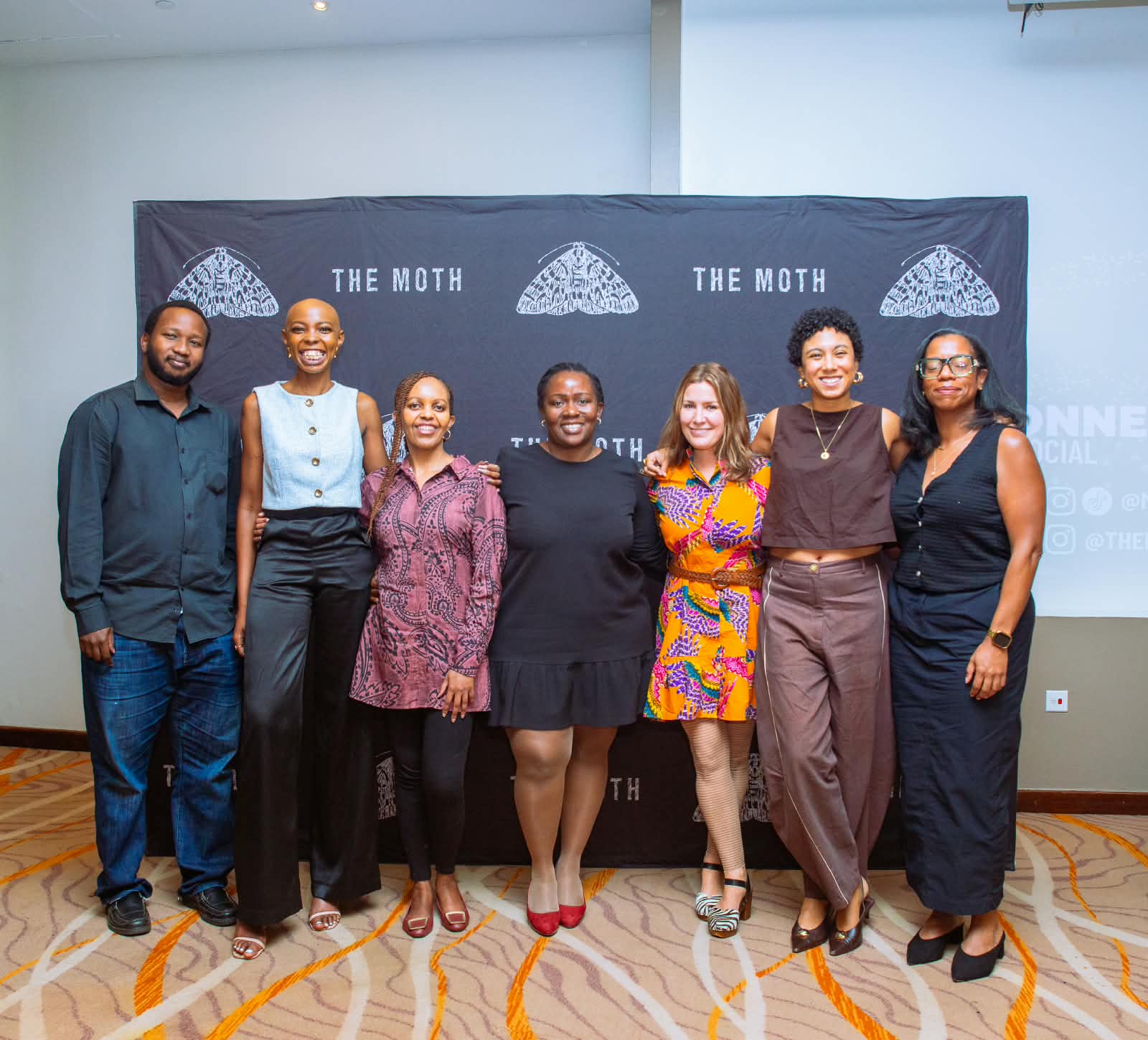
Photo caption: The Moth leadership, storytellers and facilitators pose for a group photo during a media roundtable in Nairobi on November 6, 2026.
NAIROBI, November 6,2026 – The Moth, a global storytelling organisation, has urged journalists to embrace personal storytelling in news coverage, saying sharing lived experiences can humanise reporting, influence public policy and inspire social change.
Personal storytelling provides an opportunity for people to communicate experiences that might otherwise remain unheard, helping audiences connect with issues beyond statistics and headlines.
Speaking during a media roundtable at Tamarind Hotel in Nairobi on Friday, a day before the organisation’s seventh Nairobi Mainstage event, Gina Duncan, Chief Executive Officer of The Moth, said the organisation was exploring new ways of telling stories while expanding its programmes across Africa.
“I have been with the organisation for nine months now as CEO, and one of the main things I am looking at is a different way of telling stories. We have mostly been doing first-person stories, and Africa is in the middle of what we are doing globally,” she said.
Duncan said the organisation, which has been in existence for 30 years, was keen to learn from Africa’s rich oral storytelling traditions and work with local instructors and facilitators to incorporate different cultural perspectives into its programmes.
She noted that support from the Gates Foundation had enabled The Moth to expand its activities beyond Kenya and South Africa to other African countries, including Nigeria, Senegal, Somalia and Ethiopia, while creating more opportunities for African storytellers to reach international audiences through its platforms.
The Moth Executive Producer Sarah Austin Jenness said personal storytelling had demonstrated its ability to influence policy and bring attention to issues that might otherwise be overlooked.
She cited the experience of Kenyan storyteller Rosalind Orwa, whose personal account of widowhood and the challenges women face in inheriting property after losing their husbands contributed to advocacy efforts that led to the adoption of the United Nations Widowhood Resolution in 2023.
Jenness, who has been with the organisation for nearly 22 years, said storytellers were encouraged to share experiences they had processed and gained perspective on rather than exposing themselves to further emotional distress.
“We always ask storytellers to share from a scar and not a wound. If it is an open wound, that is a very sacred space, and for storytelling you need to have some perspective,” she said.
The Moth Editorial Director of Podcast and Radio Hour Chloe Salmon said developing compelling personal stories required careful listening, collaboration and identifying the experiences that shaped an individual’s life.
She explained that the organisation works with storytellers to develop their narratives, selecting details that communicate the central message while preserving their natural voices and ensuring they are comfortable with what they share.
“My job as a director is to honour those experiences and make sure that when the storyteller is sharing their story, it is something they feel comfortable telling,” Salmon said.
Josephine Macharia, producer of the Nairobi Mainstage and founder of Bluegrass Solutions, said storytelling and journalism shared the responsibility of bringing communities together through meaningful accounts of people’s experiences.
She observed that journalism was increasingly moving beyond communicating with large audiences towards creating personal connections, adding that journalists could draw lessons from storytelling by giving human experiences greater attention in their coverage.
Former journalist and media entrepreneur Adelle Onyango, founder of Legally Clueless Africa and host of the Nairobi Mainstage, said her involvement with The Moth had strengthened her understanding of empathy and the ability of personal experiences to connect people across different backgrounds.
She recalled sharing a story about grieving her mother, which resonated with audiences even beyond Kenya, demonstrating that personal experiences could create common ground among people from different cultures.
Onyango challenged journalists to prioritise the dignity of people whose experiences they report on instead of focusing on sensational headlines and attracting online traffic.
“The lived experience as it is, is not only good enough, it is great. It is important to remember the person in all the breaking news, even when all the clicks are done,” she said.
Dr Michael Maina, a medical doctor and former Moth storyteller, said the programme had transformed his approach to patient care and health advocacy by teaching him the importance of empathy and listening to people’s experiences.
He recalled how personal accounts from teenage mothers helped his youth-led advocacy team persuade Nairobi County decision-makers to triple the budget allocated to young people and adolescent sexual and reproductive health services.
Maina said the experience demonstrated that personal accounts could be more persuasive than statistics alone, particularly when seeking policy changes.
He added that storytelling had also helped him become more understanding of patients, especially those who might not readily accept medical advice or treatment.
“Taking a patient’s history is essentially listening to their story. You have to listen, understand what they are telling you and examine them. That is a very important part of making a diagnosis,” he said.
Maureen Amakabane, a Moth instructor and entrepreneur involved in women and youth empowerment, said the programme had broadened her understanding of diversity and taught her to listen to people’s experiences without imposing personal beliefs or judging them.
“Being raised as an African child, The Moth helped me learn about diversity. Listening to other people without being judgemental has been amazing,” she said.
The roundtable brought together seven speakers from The Moth and its storytelling community to examine how personal experiences are identified, developed and shared, with lessons for journalists covering sensitive social and health issues.
The discussions were held ahead of the organisation’s seventh Nairobi Mainstage event scheduled for November 7 at the Catholic University of Eastern Africa under the theme “Now or Never”.
Five storytellers from Kenya, Uganda, Nigeria and Sierra Leone are expected to share personal experiences touching on HIV, tuberculosis, survival, safety and family responsibility.