

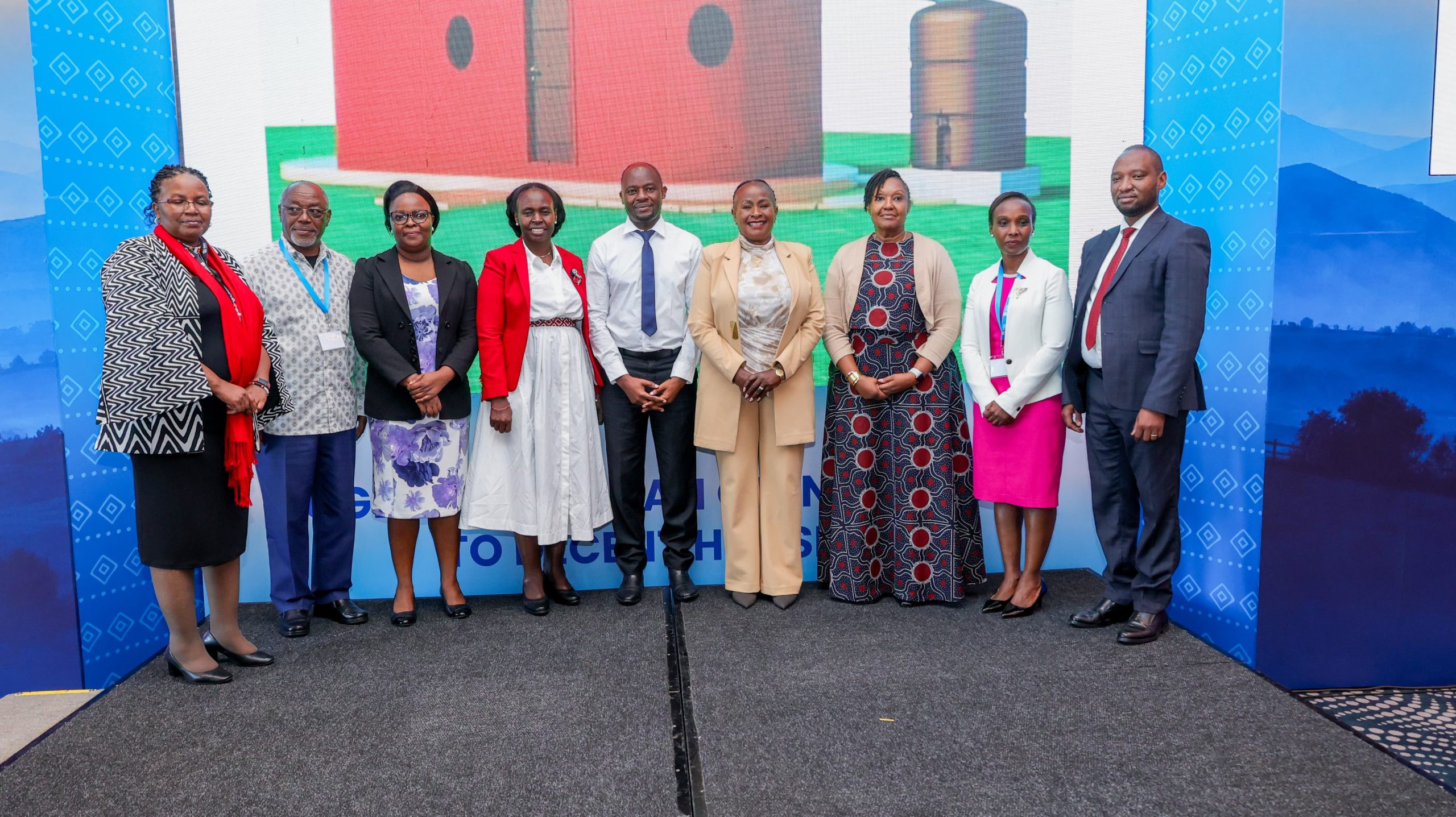
From left: Habitat for Humanity Kenya National Director Dr Eileen Mokaya former Habitat for Humanity Board Chairperson,Kajiado County First Lady Edna Lenku, Dr Wycliffe Omondi of the Ministry of Health , Machakos Governor Wavinya Ndeti , Habitat for Humanity Area Vice President for Africa Abi Riak and Habitat for Humanity Board Chairperson Rose Sang, during the launch of the organisation’s Let’s Open the Door campaign in Nairobi on July 16, 2026.
NAIROBI, July 16, 2026 — Habitat for Humanity has launched the Let’s Open the Door campaign in Kenya to promote housing as a foundation for improved health, climate resilience, economic opportunity and human dignity, while unveiling initiatives targeting resilient traditional homes and jigger-infested households.
The campaign, launched as Habitat for Humanity marks 50 years of global impact, seeks to raise awareness of the housing crisis and mobilise partnerships, innovation and investment in scalable solutions that improve living conditions and strengthen communities.
Speaking during the launch in Nairobi, Habitat for Humanity Area Vice President for Africa Abi Riak said the scale of Africa’s housing challenge required stronger partnerships, noting that 53 per cent of the continent’s urban population lives in informal settlements while the region faces a housing deficit of 56 million units.
“Housing is more than shelter. It influences health outcomes, education outcomes, economic opportunities, resilience to climate shocks and dignity. When we open the door to housing, we open the door to development and opportunities for communities to thrive,” Riak said.
Riak said Habitat for Humanity had reached more than 65 million people globally over the past five decades but needed stronger partnerships to address the growing housing crisis.
“We need partnerships. We cannot do this alone. The next 50 years will require us to think bigger, partner differently and place housing at the centre of development,” she said.
Riak said Kenya was well positioned to address its housing challenge through progressive reforms, financial inclusion and partnerships that could promote housing inclusion and Habitat for Humanity was working with partners, including the Kenya Medical Research Institute, to advance healthy housing solutions, noting that pilot studies had shown that some housing innovations could reduce the presence of malaria-causing mosquitoes in homes by 77 per cent.
The campaign will be implemented in Kenya through two key initiatives, Opening the Door to Women Building Resilient Manyattas and Opening the Door to Jigger-Free Homes.
The resilient manyatta initiative seeks to empower Maasai women to improve traditional homes through climate-resilient and healthier housing solutions while preserving cultural heritage and strengthening women’s leadership and economic opportunities.
The jigger-free homes initiative, meanwhile, aims to improve 10,000 household floors over five years in jigger-endemic communities across Kenya, directly benefiting an estimated 50,000 people.
Habitat for Humanity Kenya National Director Dr Eileen Mokaya said the organisation’s work went beyond constructing houses to addressing access to basic services, health, education and economic opportunities.
“There is no home that we can call decent if we do not have access to basic services. Water is that essential commodity. When we extend solar lighting or electricity to the last mile, we want to ensure that decency also allows our children to have equal opportunities,” Mokaya said.
Mokaya said the resilient manyatta initiative would combine cultural preservation with improved ventilation, lighting and energy efficiency to create healthier homes for Maasai communities.
She added that the jigger-free homes programme would address the environmental conditions that contribute to jigger infestation by improving household floors.
“If you treat the person and do not treat the floor, it recurs. We also want to provide a housing solution to a health problem, and that is why we are saying we want to open the door to jigger-free homes by treating the floors,” Mokaya said.
Mokaya said Habitat for Humanity Kenya had worked in more than 18 counties since its establishment 45 years ago and was currently active in seven counties, supporting vulnerable communities to improve their housing conditions incrementally.
Machakos Governor Wavinya Ndeti said the partnership between the county and Habitat for Humanity had transformed the lives of vulnerable families through decent housing, water access and digital learning initiatives.
She said the organisation had supported communities in Matuu, Masinga and Maboko, among other areas, while collaboration in Masinga had resulted in the construction of approximately 16 kilometres of water reticulation pipelines and water kiosks.
“In Machakos County, our partnership is not just written on paper. It is written on the smiling faces of our people. Families who once lived in despair now live in decent, secure housing. You did not just build structures; you restored self-worth,” Ndeti said.
Ndeti said the county was ready to support the development of a housing policy in collaboration with the Department of Housing and called for expanded partnerships to reach more vulnerable families.
“Let us enhance this programme. Let us expand our reach and scale up the collaboration so that thousands of other families still waiting in the shadows can also have their doors opened to dignity and safety,” Ndeti said.
The Governor said Habitat for Humanity had also partnered with Computers for Schools Kenya to provide 120 computers to six public schools in Machakos County, with each school receiving 20 computers.
A beneficiary, Mary Kanini from Machakos, said the house provided by Habitat for Humanity had transformed her life and given her peace of mind, especially during the rainy season.
“Even now, when I hear it raining while I am here, I say I will sleep well with my grandchildren. It is a beautiful house, and I thank you very much,” Kanini said.
Kanini said she had never lived in a concrete house before and initially struggled to believe that the newly completed house belonged to her.
“When I entered the house, I sang because of where I had come from and where I was going. I had never stepped into a concrete house before. To me, it was like a dream,” she said.
She called on Habitat for Humanity to continue supporting other vulnerable families.
“Please continue doing the same and do more good for others. Thank you very much,” Kanini said.
Habitat for Humanity said the Let’s Open the Door campaign would continue to promote housing as a platform for improved health, livelihoods, financial inclusion, climate resilience and community development.