

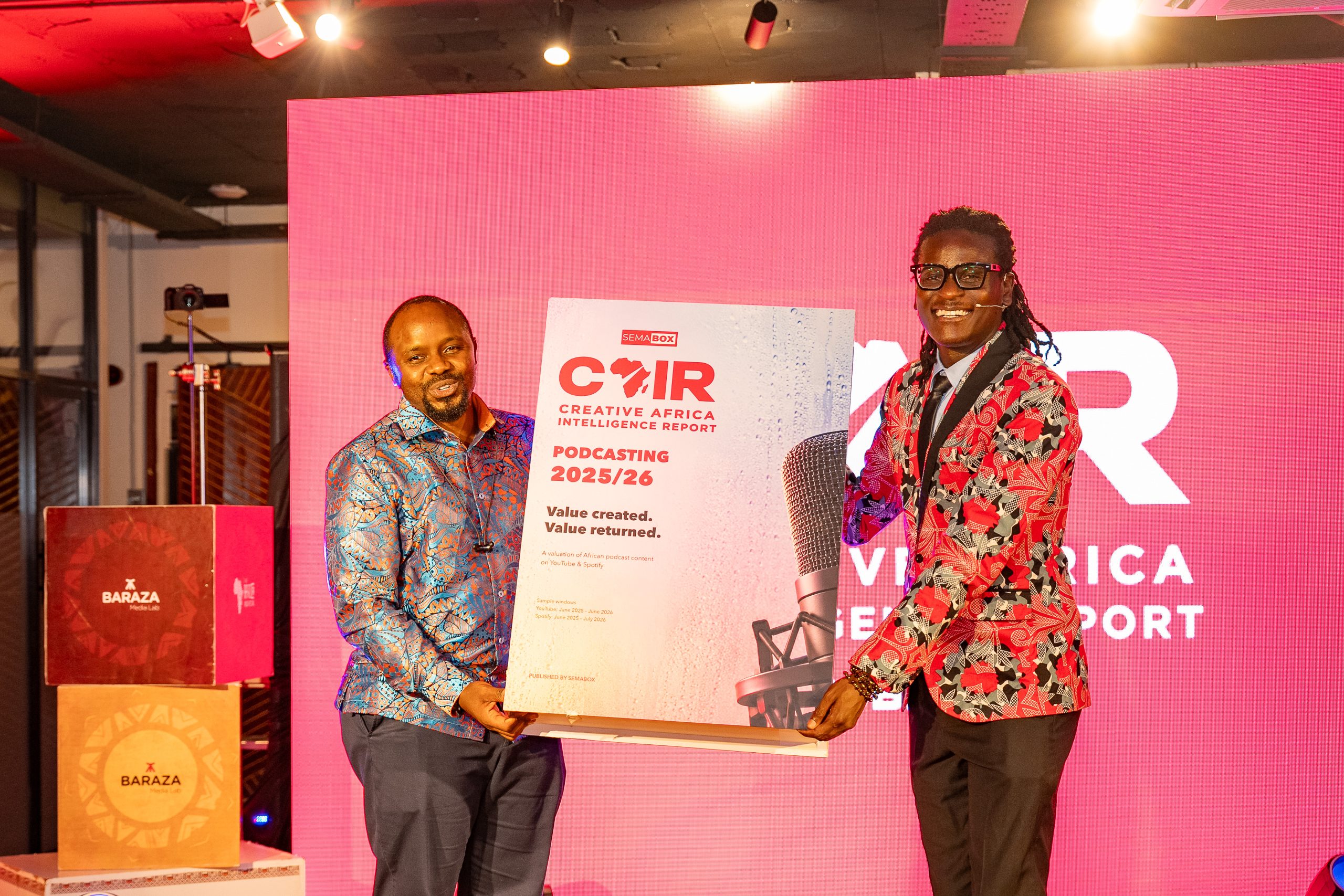
Photo Caption: Media Lab Executive Director Eric Kinaga (left) and SemaBOX Founder and CEO Dan Aceda (right) during the launch of the Creative Africa Intelligence Report 2026 in Nairobi.
NAIROBI, October 19, 2026 — African podcasts are attracting stronger audience engagement than international benchmarks but remain significantly undervalued, with creators missing out on an estimated USD 1.4 million in advertising value due to disparities in market pricing, a new report has found.
The Creative Africa Intelligence Report (CAIR) 2026, published by SemaBOX in partnership with Baraza Media Lab, estimates that the 330 podcast episodes and videos analysed could generate more than USD 2.3 million in advertising value if priced at rates prevailing in higher-paying markets, compared with more than USD 900,000 at current rates.
Speaking during the report’s launch in Nairobi, SemaBOX Founder and Chief Executive Officer Dan Aceda said African creators were producing digital content that rivalled global competitors in audience commitment but were not receiving commensurate financial returns because of structural barriers in the digital advertising industry.
“African creators are producing digital media that rivals global competitors in audience commitment and attention depth, yet they are not receiving the recognition or revenue they are due because of structural barriers,” he said.
Dan said the valuation gap presented an opportunity for global advertisers, investors and advertising technology developers to participate in Africa’s expanding digital audio market.
“The geography discount is our biggest challenge, but it is also our greatest opportunity. It is a valuation gap, and for global advertisers, investors and ad-tech developers, closing it offers a rare entry point into a fast-growing digital audio market,” he said.
The report analysed 227 YouTube videos and 103 Spotify episodes published between June 2025 and July 2026, using advertising rates available in the respective markets to estimate their commercial value.
It found that the YouTube sample recorded a weighted engagement rate of 2.75 per cent, compared with between 1.5 and 2.2 per cent in higher-paying markets. Despite the stronger engagement, the sample’s blended advertising rate was approximately 71 per cent lower than that of the comparator markets.
The disparity varied across the continent, with the report estimating an approximately twofold difference in South Africa and sevenfold in Kenya and Nigeria. In Ghana, Uganda, Tanzania, Senegal and Egypt, the gap reached almost elevenfold, based on a shared fallback rate used where reliable country-specific benchmarks were unavailable.
The report further identified limited access to digital platform monetisation programmes as a major barrier to earnings. During the study period, Spotify’s Partner Programme was unavailable in every African market, while YouTube’s Partner Programme operated in only 13 of Africa’s 54 countries.
Under the report’s modelling, approximately half of the advertising value generated through platform revenue-sharing arrangements would go to creators.
At higher-market advertising rates, the same content could support about 890 monthly income-equivalents of USD 100 over the 14-month study period, compared with approximately 352 at prevailing rates, without additional views.
Baraza Media Lab Executive Director Eric Kinaga said the report raised fundamental questions about how African creative talent could translate audience recognition into sustainable livelihoods.
“The African creative economy has been celebrated for its potential, its talent, its storytelling and the traditions around our young people and their imagination. But we’ve reached a point where we need to ask some other harder questions,” he said.
Kinaga said African creators were attracting audiences but were not receiving a proportionate share of the economic value generated by their work.
“Our African creators are commanding attention across the globe. What they’re not commanding is a proportionate share of its economic value,” he said.
He called on global platforms to provide fair access to monetisation opportunities and urged investors, advertisers and governments to treat the creative economy as a serious economic sector rather than a charitable undertaking.
Kinaga also emphasised the need for investment in advertising systems, audience measurement and accessible payment solutions, saying African institutions had a responsibility to build and own the infrastructure needed to sustain the sector.
“African stories deserve agency, and African creativity deserves a fair return,” he said.
The report recommends that global brands and advertising agencies include African podcasts in their media plans and evaluate host-read campaigns through measurable outcomes such as completed views, referral traffic and conversions.
It also urges investors to support advertising technology, audience measurement, catalogue aggregation and creator payment systems. YouTube and Spotify are encouraged to expand monetisation access, including through a phased Spotify Partner Programme pilot in Kenya, Nigeria and South Africa.
The report estimates that Africa produces approximately 710,000 podcast publications annually, based on an estimated 10,000 open RSS feeds and 20,000 YouTube channels. However, it cautions that this is a modelled scenario rather than a verified total because the figures have not been deduplicated.
The findings call for greater collaboration among digital platforms, advertisers, investors and policymakers to ensure that Africa’s growing podcast audiences translate into sustainable income and stronger economic returns for the continent’s creative sector.