
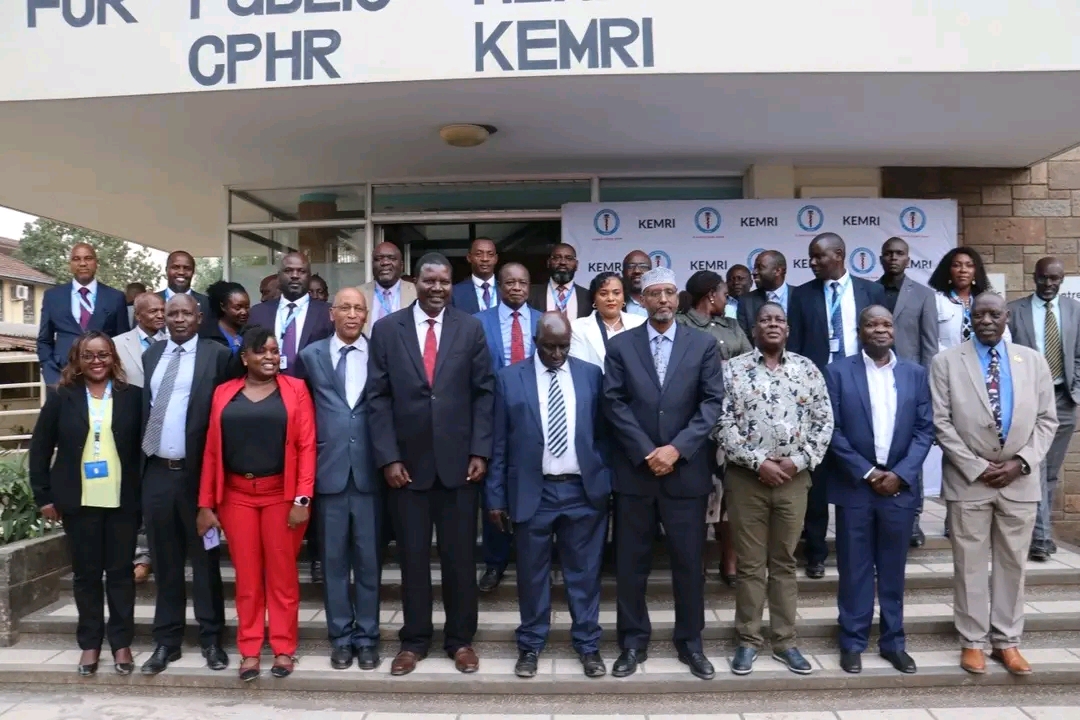
KEMRI Director-General Prof. Elijah Songok, members of the Parliamentary Health Committee and KEMRI staff pose for a group photo during an oversight and budget implementation visit at the institute in Nairobi on July 22, 2026.
NAIROBI, July 22, 2026 — The Kenya Medical Research Institute (KEMRI) has urged the government to enhance funding and policy support to strengthen health research, commercialise local innovations and improve the country’s preparedness against emerging diseases.
Speaking during an oversight and budget implementation visit by the Parliamentary Health Committee at KEMRI in Nairobi, Director-General Prof. Elijah Songok said the engagement provided an opportunity to review how resources allocated to the institution have been utilised, assess progress of programmes and identify areas requiring additional support.
“While KEMRI is now a specialised degree-awarding institution following the granting of a university charter, we remain under the Ministry of Health. The Ministry of Education provides oversight on academic matters, but our core mandate continues to be health research, innovation and capacity building in support of the country’s healthcare system,” said Prof. Songok.
Prof. Songok said the visit was significant as it was the first oversight engagement since KEMRI received the charter, which allows the institution to award degrees while maintaining its focus on health research.
He said KEMRI’s ongoing infrastructure projects, including specialised laboratories and training facilities, were critical in strengthening Kenya’s ability to respond to emerging and re-emerging diseases.
“The COVID-19 pandemic demonstrated the importance of investing in local research capacity, and today we must also remain prepared for threats such as Ebola and other infectious diseases,” said Prof. Songok.
The Director-General said although progress had been made in implementing key projects, additional funding was required to ensure their completion within the planned timelines.
He added that KEMRI scientists had developed several products, including vaccines, diagnostics, sanitisers and traditional medicine solutions, but many had not reached the public due to regulatory and procurement challenges.
“We are appealing for policy and legislative support to ensure that products developed by KEMRI receive priority within government procurement under the Buy Kenya, Build Kenya initiative. Our innovations should benefit Kenyans by reaching hospitals, health facilities and communities across the country,” he said.
Prof. Songok also called for increased domestic financing for research, noting that nearly 70 per cent of KEMRI’s research funding currently comes from external partners.
He said while donor support remains important, stronger government investment would enable the institute to focus on research areas that directly address Kenya’s health priorities.
Meanwhile, Parliamentary Health Committee Chairperson and Seme Member of Parliament Dr. James Nyikal said the visit was part of routine budget implementation assessments carried out by the committee to evaluate the performance of semi-autonomous government agencies.
Nyikal said the committee had assessed KEMRI’s expanded role following the award of its university charter and the need to align its training and research functions.
“We have noted that KEMRI does a lot of research and actually produces medical products that can be used in the market and hospitals, but we have found out that a lot of them are not marketed commercially,” said Dr. Nyikal.
He said the committee had recommended measures to support commercialisation of KEMRI’s innovations, which would generate revenue and increase the impact of research outcomes.
Dr. Nyikal added that there was a need to strengthen collaboration among institutions involved in health research, including KEMRI, BioVax, the Primate Research Institute and the National Cancer Institute.
He said a coordinated framework would help reduce duplication, encourage collaboration and ensure resources are used effectively.
The legislator said the committee would consider KEMRI’s funding requirements during the next budget cycle, noting that the institute requires significant resources to complete ongoing projects.
“As a committee of the National Assembly, when we go to the next budget session, we will see how we support KEMRI. From what we have been told, they require about Sh500 million for the projects that are ongoing,” said Dr. Nyikal.
Dr. Nyikal said supporting research institutions was essential in strengthening Kenya’s healthcare system and ensuring locally developed solutions benefit the public.