
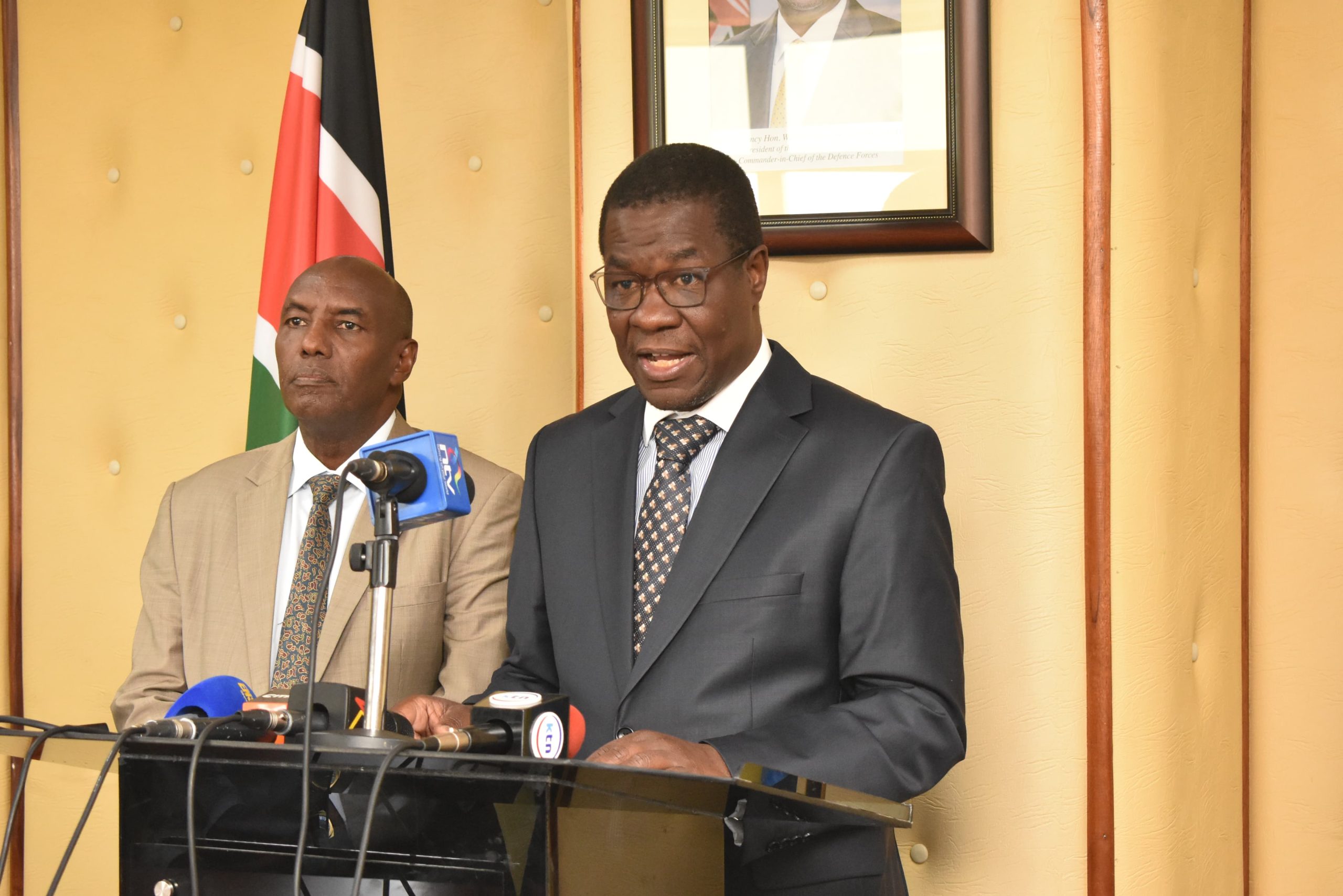
Energy and Petroleum Cabinet Secretary Opiyo Wandayi (right) addresses the media during a press briefing in Nairobi on July 14, 2026.
NAIROBI, July 14, 2026 – The government has extended the application of the eight per cent Value Added Tax (VAT) measure on petroleum products for a further three months and allocated Sh945 million from the Petroleum Development Levy to stabilise fuel prices amid renewed volatility in the global oil market.
Speaking during a press briefing in Nairobi on Tuesday, Energy and Petroleum Cabinet Secretary Opiyo Wandayi said the interventions are aimed at cushioning households, businesses and the wider economy from the effects of rising international oil prices triggered by renewed geopolitical tensions in the Middle East.
“As part of the government’s commitment to cushioning households and businesses from international market volatility, and in consultation with the National Treasury, we have extended the application period for the eight per cent Value Added Tax on petroleum products for a further three months until October 14, 2026,” said Wandayi.
The Cabinet Secretary announced that during the July-August 2026 pricing cycle, the government will deploy Sh945 million from the Petroleum Development Levy to sustain current pump prices and minimise the impact of rising international fuel costs on consumers.
He said the measures come at a time when renewed military escalation in the Middle East has disrupted commercial shipping through the Strait of Hormuz, increasing uncertainty in global energy markets and pushing up international oil benchmarks.
Wandayi, however, assured Kenyans that the country has adequate petroleum stocks and that fuel supply remains stable across the country despite the external shocks.
“The foremost objective of government has been to ensure a stable and uninterrupted supply of petroleum products. Every scheduled cargo has arrived on time, fuel has remained available across the country and our Government-to-Government arrangement has continued to guarantee reliable supply,” he said.
The CS explained that the Government-to-Government (G2G) fuel import framework has enabled Kenya to maintain fixed freight and premium costs even as global shipping and insurance charges continue to rise due to market instability.
He noted that while countries relying on spot market purchases have experienced escalating freight costs, Kenya has continued sourcing cargoes from alternative loading regions without passing additional costs to consumers.
“The arrangement is doing exactly what it was built to do. The fixed freight and premium costs have kept Kenya’s landed fuel costs under control and allowed suppliers to source cargoes from alternative regions without transferring the cost of that flexibility to Kenyan motorists,” Wandayi said.
He added that although international oil prices have begun rising again following the renewed Middle East crisis, the government will continue working closely with industry stakeholders to safeguard fuel supply, protect the gains made under the G2G arrangement and keep the public informed on market developments.
Wandayi further said Kenya’s energy security has been strengthened through strategic investments in the petroleum sector, including improved import and distribution systems that have enhanced the country’s ability to withstand external market shocks.
He reassured motorists, manufacturers, farmers, transport operators, investors and other consumers that there is sufficient fuel across the country and pledged that the government will continue implementing measures to ensure petroleum products remain available and as affordable as possible under prevailing global market conditions.