
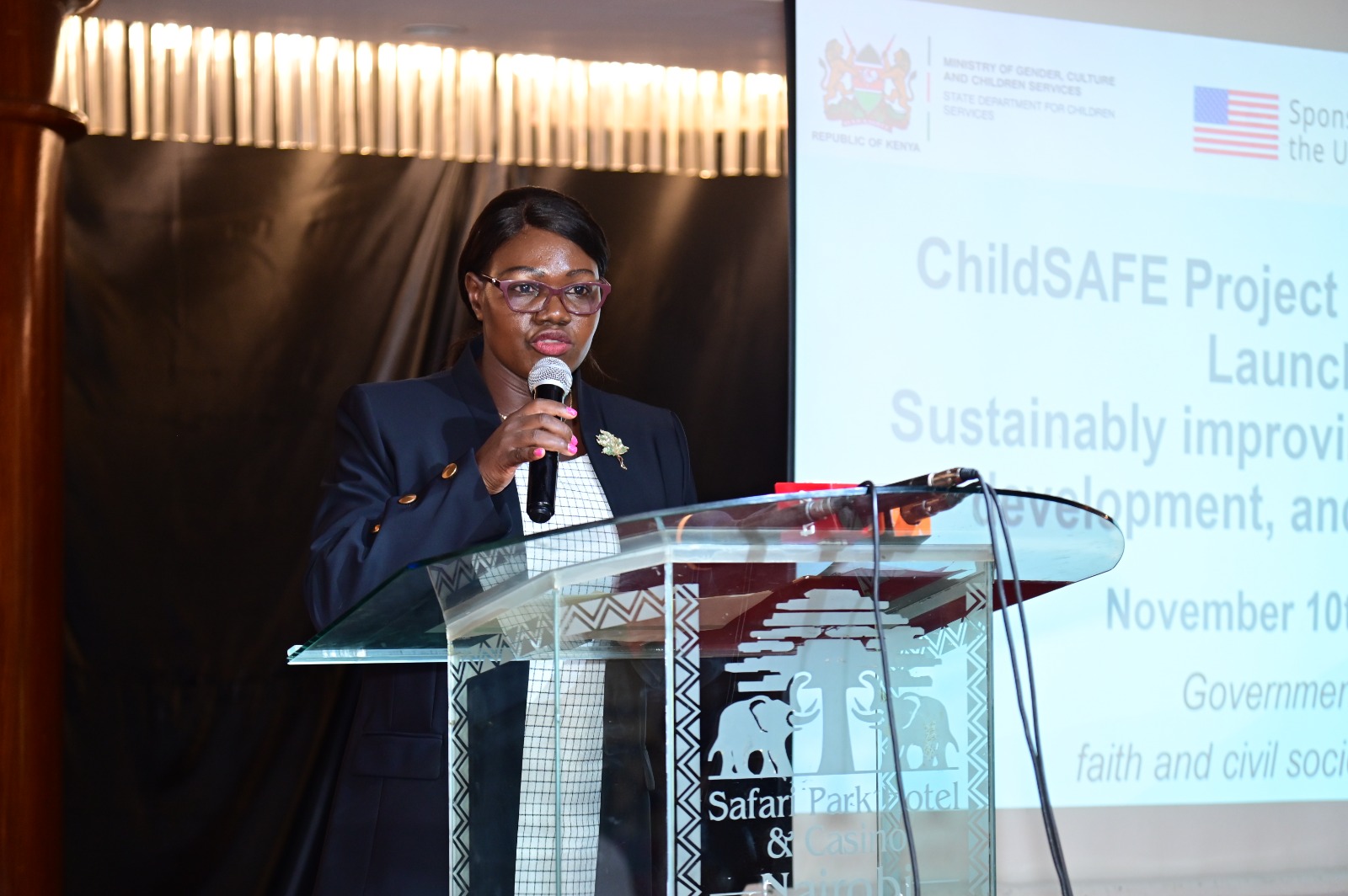
Photo caption: Principal Secretary for the State Department for Children Services CPA Carren Ageng’o delivers her keynote address during the official launch of the ChildSAFE Kenya Project in Nairobi on November 10, 2026.
NAIROBI, November 10,2026 – The Government has launched a child protection initiative targeting six counties to strengthen family-based care, improve early childhood development and enhance systems for preventing violence, abuse and neglect against children.
The ChildSAFE Kenya Project, supported by the United States Department of State and implemented by Catholic Relief Services (CRS) in collaboration with partners, will focus on Kisumu, Kakamega, Nairobi, Kajiado, Mombasa and Kilifi counties.
The initiative seeks to strengthen child protection systems and referral pathways, promote integrated early childhood development and nurturing care, and prevent unnecessary family separation through family strengthening and alternative family-based care.
Speaking during the launch at Safari Park Hotel in Nairobi on Tuesday, Principal Secretary for the State Department for Children Services CPA Carren Ageng’o said the project was aligned with the department’s mandate, strategic priorities and 2026/2027 financial year work plan.
“ChildSAFE Kenya comes at an opportune time as Government strengthens national and county-level systems for child protection. We therefore welcome ChildSAFE Kenya as a strategic partner in advancing our national priorities on child protection, early childhood development and care reform,” she said.
Ageng’o said the initiative would address violence against children, neglect, abuse and exploitation while strengthening family-based care, psychosocial support and referral services.
She said the project would also improve reporting, referral and case management through existing government platforms, including the Child Protection Information Management System (CPIMS), VuruguMapper and Child Helpline 116.
“As we strengthen these platforms, the confidentiality, dignity and best interests of children must remain paramount, in accordance with the Data Protection Act, 2019,” she said.
The Principal Secretary emphasised the need for clear institutional responsibilities, stronger coordination and investment in the social service workforce to ensure sustainable implementation.
She further called for the safe reintegration of children from residential institutions into families and communities, guided by the Children Act, 2022, the National Care Policy, 2025 and the National Care Reform Strategy 2022–2032.
CRS Country Manager Margaret Kahiga said the initiative marked an important step in strengthening collective efforts to ensure children grow up in safe, supportive and nurturing environments.
“Protecting children is not the responsibility of one institution alone. It requires the collective efforts of government, communities, families, faith leaders, development partners and children themselves,” Kahiga said.
She noted that despite progress in strengthening child protection and community-based care in Kenya, many children continued to face poverty, violence, neglect, abuse, harmful practices and family separation.
Kahiga said ChildSAFE would address these challenges by strengthening protection systems, supporting families and promoting appropriate alternative care where necessary.
“Children flourish best in safe, loving and stable family environments, and strong communities are essential for protecting and nurturing the next generation,” she said.
She added that faith-based institutions, including churches and mosques, had an important role in safeguarding children because of their close relationships with families and communities.
UNICEF Chief of Child Protection in Kenya Eri Mathers Suzuki reaffirmed the organisation’s commitment to working with the Government and other partners to strengthen child protection systems and ensure children grow up in safe and nurturing families.
“Kenya has a very strong foundation for children and young adults. We have a National Care Reform Strategy and a very strong community of practice for care reform,” she said.
Mathers Suzuki observed that declining resources for social development and child protection made partnerships increasingly important in sustaining progress and expanding access to essential services.
She noted that UNICEF had supported child protection information management systems over the years and would continue working with the Government and coalition partners to improve services for vulnerable children.
“We are here for over five decades. But in particular, since 2021, this has been happening,” she said, referring to UNICEF’s longstanding engagement in supporting child protection systems.
She said the organisation remained committed to working closely with the Government and other partners to ensure children grew up in safe families with access to quality protection services.
Meanwhile, Joint Forces Alliance for Children chairperson Walter Odhiambo pledged the alliance’s support for the initiative, saying collaboration among child-focused organisations was essential in strengthening child protection efforts across the country.
He said six organisations had come together about eight years ago to establish the alliance, bringing their expertise and resources together to advance the common goal of safeguarding children.
“Six leading child-focused agencies saw the need to continue protecting children in this country. It was a powerful move for organisations to come together, putting aside their individual interests to form what we call the Joint Forces Alliance for Children,” Odhiambo said.
The alliance brings together World Vision International, Plan International, Save the Children International, ChildFund International, Terre des hommes and SOS Children’s Villages International.
Odhiambo said the organisations remained committed to working with the Government and other stakeholders to ensure children received the protection and support they needed.
“We give our commitment as Joint Forces Alliance to partner with everybody who is focused on the children of this country,” he said.
The ChildSAFE Kenya Project is expected to strengthen coordination between national and county institutions, community structures and implementing partners while generating evidence from the six counties to inform child protection policies and programmes nationally.
The initiative will also build the capacity of social service workers, caregivers and community-based child protection structures to identify risks, report cases and provide appropriate support to children and families.