
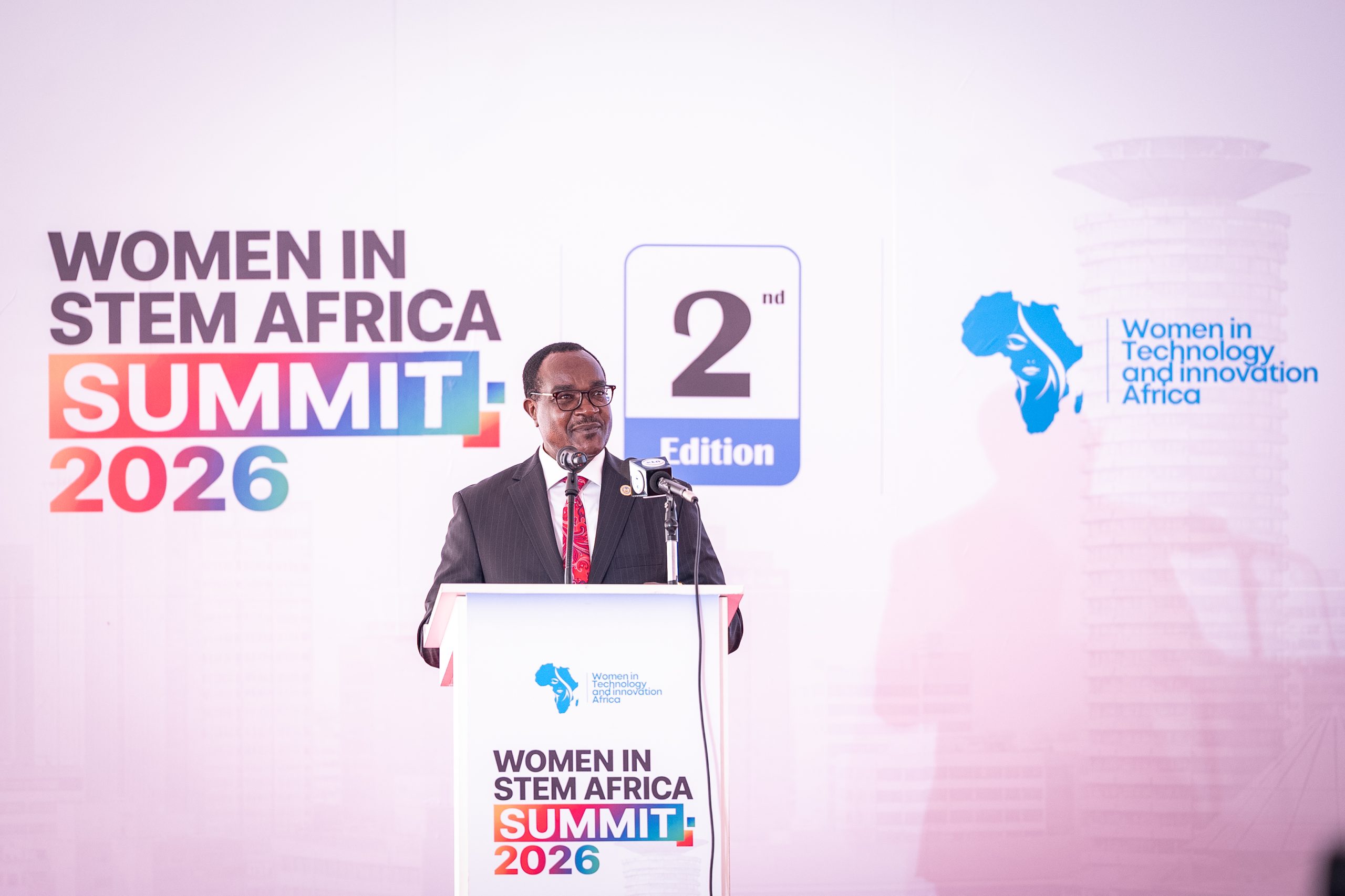
Photo Caption:Education Cabinet Secretary Julius Migos Ogamba speaks during the Women in STEM Africa Summit 2026 in Nairobi on September 3, 2026.
NAIROBI, September 3, 2026 — African countries have been urged to strengthen pathways for women and girls to participate and take leadership in science, technology, engineering and mathematics (STEM) as the continent seeks to harness innovation for social and economic transformation.
Speaking during the Women in STEM Africa Summit 2026 in Nairobi, Education Cabinet Secretary Julius Migos Ogamba said Africa has abundant talent across schools, universities, technical and vocational institutions and innovation hubs, but called for deliberate efforts to identify, nurture and connect that talent to opportunities.
“Our responsibility as leaders is to ensure that this talent does not remain invisible or unsupported. We must build a complete STEM pipeline that connects the classroom to skills, skills to innovation, innovation to enterprise, enterprise to investment, and investment to impact,” said Ogamba.
He said education should go beyond knowledge transmission and examination preparation by giving learners opportunities to develop confidence, curiosity and practical skills to solve real-world problems.
Ogamba said social expectations, stereotypes and unequal access to opportunities have continued to influence girls’ choices in education and careers, stressing the importance of representation, mentorship and role models in encouraging more girls to pursue STEM careers.“We must ensure that girls growing up in Africa can see women succeeding in STEM and understand that these fields belong to them as much as they belong to anyone else,” he said.
He said Africa should increasingly become a creator of technologies, intellectual property and technological solutions rather than remaining predominantly a consumer of innovations developed elsewhere.
Ogamba challenged young people to shift their mindset from asking what job they could get to asking what problems they could solve, noting that challenges in agriculture, healthcare, education, financial inclusion and climate change present opportunities for innovation.
On artificial intelligence, he said women should be involved not only in using emerging technologies but also in developing, researching and governing them.
“We need women not only to use artificial intelligence, but also to build it, to research it, govern it and shape the way it’s deployed in our societies,” said Ogamba.
Principal Secretary for Higher Education and Research Beatrice Inyangala said Kenya’s efforts to advance STEM must move beyond providing access to creating opportunities for women to exercise agency and assume leadership in research and innovation.
She said women remain underrepresented in research, making it necessary to strengthen opportunities for women to lead research programmes, laboratories, centres of excellence and innovation initiatives.
“Getting through the door is not the same as getting at the table. Our ambition must therefore move from access to agency, from participation to leadership, from being users of technology to becoming creators of technology,” said Inyangala.
Inyangala urged universities, industry and investors to work together to create opportunities for girls and women through research, mentorship, employment and access to capital.
She also challenged young women to pursue STEM careers despite stereotypes, urging those interested in engineering, science and artificial intelligence to remain committed to their ambitions.
“To every girl who has ever been told that science is not for girls, it is not true. You can do it,” she said.
Women in Technology and Innovation Africa (WITIA) Founder and Chair Eunice Pohlmann said the summit provides a platform for government, academia, industry, development partners, innovators and young people to build partnerships that can accelerate Africa’s technological development.
Pohlmann said the diversity of stakeholders gathered at the summit was important because Africa’s technological challenges require collaboration across different sectors.
“This is because the challenges we are trying to address cannot be solved by anyone alone. Sometimes the greatest value of a summit like this does not necessarily come from what happens on this stage. It comes from the conversations that happen between the sessions, between people,” said Pohlmann.
She encouraged participants, particularly young people and students, to actively engage with leaders, innovators and potential mentors, saying meaningful connections could open doors to new opportunities.
“Please make the most of being in this room. Don’t be afraid to walk up to someone you admire and introduce yourself, ask questions, tell people what you are interested in, what you are building or what you hope to become,” she said.
The summit is being held under the theme “Discovering Talent, Driving Innovation, Shaping Africa’s Future,” bringing together stakeholders from government, academia, industry, research and technology to discuss ways of strengthening women’s participation and leadership in STEM and innovation.