

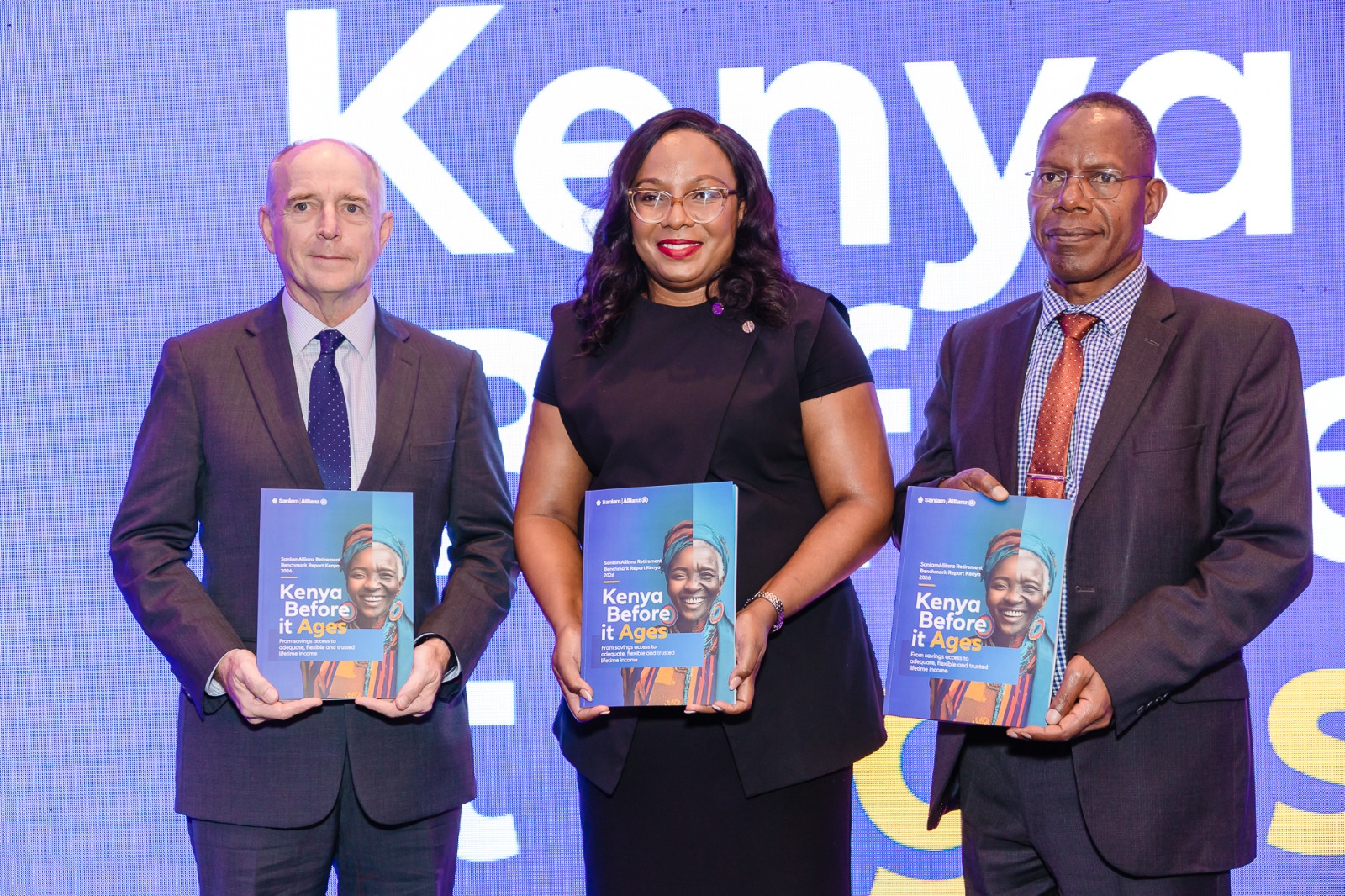
Photo Caption : From left Jonathan Stichbury, Managing Director and Chief Executive Officer, SanlamAllianz Investments Limited; Jacqueline Karasha, Chief Executive Officer and Principal Officer, Sanlam Allianz Life Insurance (Kenya) Limited; and Dr Nyamemba Patrick Tumbo, Group Chief Executive Officer, SanlamAllianz Kenya, during the launch of the SanlamAllianz Kenya Retirement Benchmark Report 2026 in Nairobi on October 12, 2026.
NAIROBI, October 12, 2026 — Many Kenyans risk entering retirement without adequate financial security as household obligations, unstable earnings and the withdrawal of savings after leaving employment continue to undermine long-term financial planning, a new survey has found.
The inaugural SanlamAllianz Kenya Retirement Benchmark 2026, released in Nairobi Monday, found that seven in 10 respondents were not on track for a comfortable retirement, despite widespread awareness of the need to save for later life.
The report, themed “Kenya Before It Ages,” points to a gap between understanding the importance of retirement planning and being able to sustain it amid competing financial demands.
Speaking during the launch, Jacqueline Karasha, Chief Executive Officer and Principal Officer of Sanlam Allianz Life Insurance (Kenya) Limited, said Kenya needed to translate financial inclusion into lasting economic security.
“Kenya has made remarkable progress in expanding financial access and inclusion. The next challenge is ensuring that financial participation translates into long-term financial security,” Karasha said.
She added that retirement should allow people to maintain their independence and make choices about their lives rather than face financial limitations.
The survey identified household and family expenses as the leading obstacle to saving, cited by 44 per cent of respondents. Low or irregular income followed at 37 per cent, while 24 per cent pointed to debt repayments.
Family responsibilities also affected savings, with 62 per cent saying support for dependants reduced their ability to put money aside. Nearly four in 10 respondents said they could meet basic household expenses for no more than two months if their income stopped.
Financial pressure was also reflected in the use of retirement funds when people left employment or businesses. Among respondents who exited with retirement savings, 53 per cent withdrew at least part of the money, while 26 per cent took the entire amount.
Only 32 per cent retained or transferred their full savings.Although some used the funds to establish or support businesses and farms, 53 per cent later regretted withdrawing the money
.“The findings show that most Kenyans understand the importance of saving for retirement, yet everyday financial pressures often compete with long-term goals. This is why preservation cannot rely on awareness alone,” Karasha said.
She called for improved guidance when people make important financial decisions and solutions that reflect the realities of their lives.
Jonathan Stichbury, Managing Director and Chief Executive Officer of SanlamAllianz Investments Limited, said the next priority was ensuring that accumulated savings could support people throughout retirement.
“Retirement security is ultimately not about the balance someone accumulates during their working years, but whether those savings can provide a reliable income throughout retirement,” Stichbury said.
The study found that only 29 per cent of respondents knew how much monthly income they would need after leaving the workforce, while one in five working-age contributors did not know the amount they had saved.
Although 51 per cent wanted a guaranteed monthly income for life, 45 per cent had never heard of income drawdown, a method of accessing retirement savings as income.
Healthcare costs presented another challenge, with 53 per cent reporting that they had no funded plan for medical expenses after retirement.Stichbury said Kenya needed to move beyond encouraging people to save towards helping them translate their accumulated funds into dependable retirement income.
The survey also highlighted the implications of informal employment, which accounted for 87.2 per cent of new jobs in 2025, according to the Kenya National Bureau of Statistics.
Among working respondents, 39 per cent reported fluctuating monthly earnings, while 51 per cent of informal workers preferred making retirement contributions through mobile money.
Meanwhile, 45 per cent of respondents said they had lost money or personal information through digital financial scams, rising to 54 per cent among younger participants.
Dr Nyamemba Patrick Tumbo, Group Chief Executive Officer of SanlamAllianz Kenya, said the country’s young population presented an opportunity to strengthen retirement preparedness before demographic pressures intensified.
“Kenya has a rare advantage: time. As a relatively young country, we have an opportunity to strengthen retirement preparedness before demographic pressures become more pronounced,” Tumbo said.
The inaugural study surveyed 300 earners aged 20 to 39, those aged 40 to 64 and retirees. The findings are indicative and are not nationally representative of the Kenyan population.