
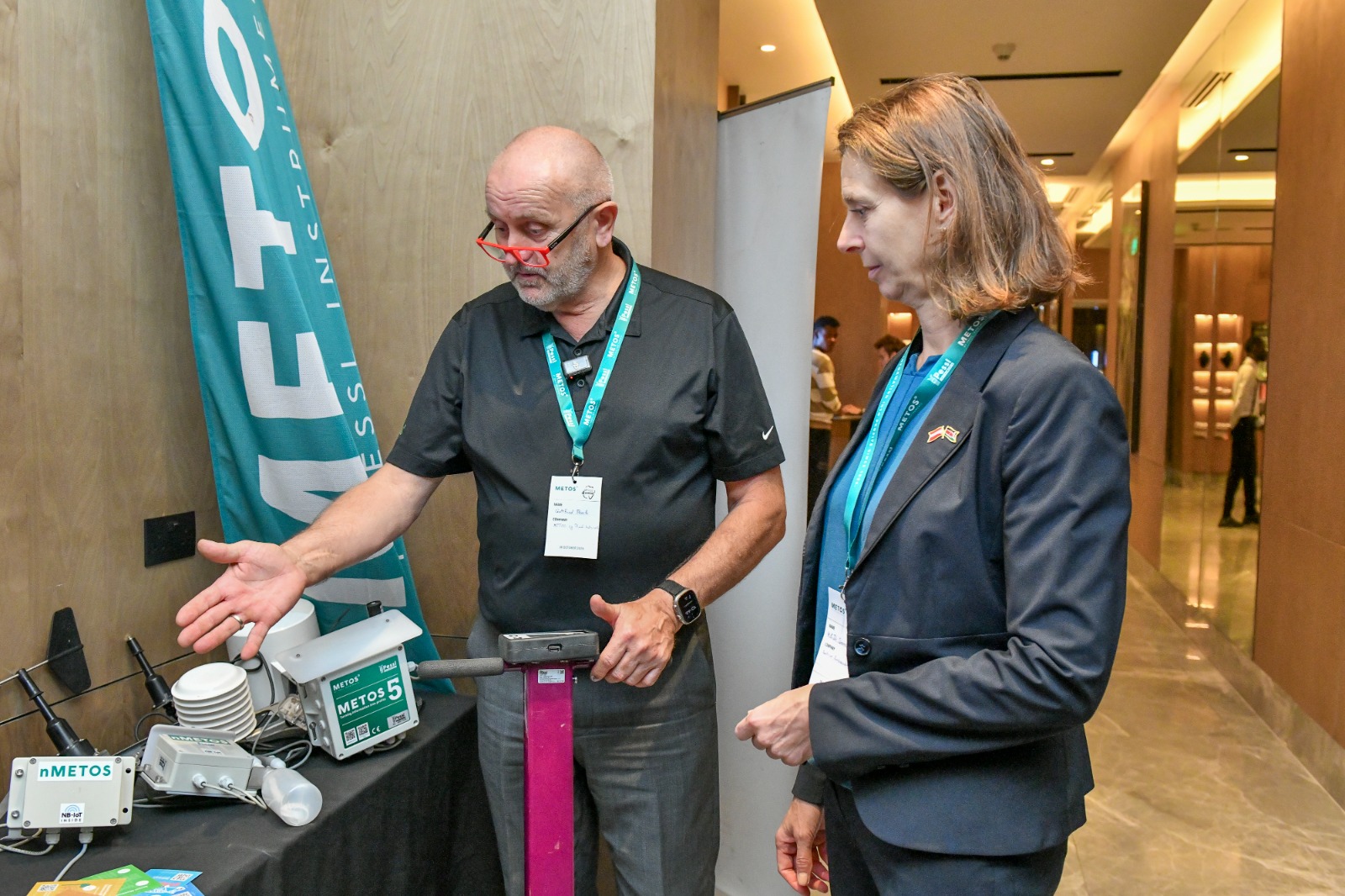
Photo Caption: Instruments CEO Gottfried Pessl showcases the company’s smart weather monitoring technology to Austrian Ambassador to Kenya Dr Simone Knapp during the launch of UpYield4Africa in Nairobi.
NAIROBI, October 30 ,2026 – Austrian agricultural technology company Pessl Instruments plans to deploy up to 100,000 smart weather stations across Africa, beginning with 15,000 in Kenya, in an initiative aimed at improving smallholder farmers’ productivity, climate resilience and access to agricultural markets.
The initiative, dubbed UpYield4Africa, was launched in Nairobi on Friday, bringing together agricultural technology providers, financial institutions, farming businesses and other stakeholders to explore how real-time weather information can strengthen agricultural production and commercial farming.
The weather stations, developed under the company’s METOS brand, will collect field-level data on rainfall, temperature, humidity, soil moisture and leaf wetness, transmitting the information to its FieldClimate digital platform to provide farmers with weather forecasts, crop disease models and other agricultural advisory services.
Speaking during the launch, Pessl Instruments Founder and Chief Executive Officer Gottfried Pessl said the technology would enable farmers to make informed decisions using accurate, location-specific weather information rather than relying largely on traditional weather patterns.
“Smallholder farmers need reliable, localised information to make better decisions throughout the farming cycle. By combining field-level measurements with weather forecasts and disease models, we can help farmers anticipate risks, improve resource utilisation and increase productivity,” he said.
He said the technology would support decisions on irrigation, planting schedules, fertiliser application and pest and disease management, helping farmers minimise losses and improve yields.
Austrian Ambassador to Kenya Dr Simone Knapp said the initiative reflected Austria’s commitment to building long-term partnerships with Kenya to address agricultural productivity and food security challenges.
She said Austria was investing in Kenya through proven agricultural technologies and partnerships that would support farmers beyond the initial deployment of equipment.
“Farming is sustainable, and also the farmers can make a living out of it, they will stay in the home, and of course also prosper in the future,” said Dr Knapp.
She added that Kenya’s telecommunications infrastructure, particularly the network provided by companies such as Safaricom, would support the delivery of agricultural information to farmers, including those in remote areas.
Antti Hintikka, Chief Executive Officer of Viazi, said Africa had significant potential for agricultural technology, particularly given the limited availability of reliable weather information at farm level.
He cited Kenya’s 37 operational weather stations as an indication of the need to expand monitoring infrastructure to provide more precise information for agricultural planning.
“At the end of the day, this information needs to be digestible in a way that you can bring it into real action. We need to bring down this information to the field level, not just the county or state level,” said Hintikka.
He explained that accurate field-level information would help farmers determine when to irrigate, apply crop protection products and prepare for pest and disease outbreaks, adding that local partnerships would be essential in expanding access to the technology.
Beyond weather monitoring, UpYield4Africa seeks to establish a commercially sustainable community farming model connecting smallholder farmers to agricultural advisory services, input suppliers, shared infrastructure, financial institutions and produce buyers.
Under the model, farmers will be organised into production clusters supported by Digital Farm Advisors, who will help interpret agricultural data, guide farming decisions and coordinate production according to market requirements.
Moses Musyo, Co-founder of Hektari, said the success of agricultural technology depended on translating collected data into practical information that farmers could use and that financial institutions could rely on when assessing credit applications.
Drawing from his company’s experience monitoring approximately 15,000 hectares in Rwanda and working with agricultural associations and cooperatives, he said combining farm management information with climate data could help address financing challenges facing smallholder farmers.
“The problem has always been how we turn this data into value that farmers can pay for. Our role is to turn all this into systems that they can understand,” said Musyo.
He explained that Hektari had developed three main solutions covering digital farm advisory services, farm management systems and credit-scoring models, with the latter offering significant commercial potential.
By combining climate information with farm-level records and other agricultural data, Musyo said financial institutions could develop better assessments of farmers’ production capacity and creditworthiness.
He noted that limited access to finance, inadequate record-keeping and gaps in technical knowledge continued to constrain smallholder farmers, making reliable agricultural data important in improving accountability and helping lenders make informed financing decisions.
The proposed financing component of UpYield4Africa will involve a bank-to-bank arrangement between Austrian financing institutions and a Kenyan banking partner.
Under the proposed structure, financing would be accessed through cluster companies or produce offtakers against eligible equipment and crop purchase arrangements, reducing the need for individual farmers to provide personal assets or land as collateral.
KCB’s participation remains provisional, with the financing structure subject to lender due diligence and the necessary approvals, including from Austria’s OeKB.
The launch brought together representatives from across the agricultural value chain, including Safaricom, Bayer Crop Science, Lindsay, HZPC and Viazi, alongside a live demonstration of METOS monitoring technology and panel discussions on agricultural data, technology integration and the commercial sustainability of community farming systems.
Founded in 1984 and headquartered in Weiz, Austria, Pessl Instruments develops agricultural monitoring and decision-support technologies under its METOS brand, with a presence in 85 countries through affiliates, subsidiaries and distribution partners.