

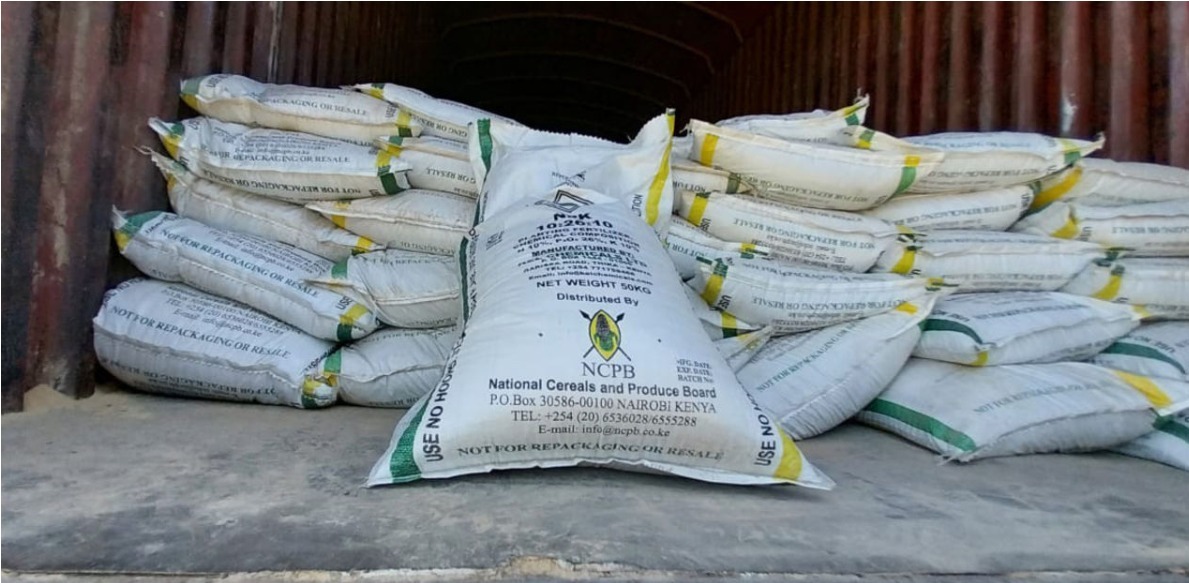
Photo Caption: Bags of subsidised NPK 10:26:10 fertiliser distributed by the National Cereals and Produce Board (NCPB). (Photo Credit: Standard)
By Berryl Jelagat Kiptanui
When the High Court delivered its judgment on 7 October 2026 on the subsidy fertiliser that reached farmers in 2024, it put into law a grievance that had been building for two seasons. In a petition brought by the Law Society of Kenya, Justice Gregory Mutai found that the State had allowed fertiliser that fell short of its declared quality onto the market, and that this breached the consumer rights guaranteed by Article 46 of the Constitution, including the right to goods of reasonable quality and to the information a buyer needs to protect their interests.The court also faulted the failure to constitute the statutory board that is meant to watch over fertiliser long before it reaches a shop.
What the ruling did not do is just as telling.It ordered no compensation for the farmers who planted in good faith and watched a season come to nothing, on the reasoning that their losses had not been identified and proved.For the ordinary grower, then, the judgment carries a hard lesson. The law now recognises the right to a decent product, but it will not, on its own, put maize back in the store.The surest protection a farmer has is still the one exercised at the point of sale: the decision about whose bag to carry home.
Some of that decision can be made with the eyes.A genuine product states its full nutrient composition, its net weight, the manufacturer and a batch number, and a label that is vague or incomplete should raise doubt.The standardisation mark matters, as does buying from a registered agro-dealer who issues a real receipt, because a seller who can trace a product is a seller who expects to answer for it.The fertiliser itself should be dry and free-flowing, even in colour and granule size. Heavy caking, dampness, a cloud of dust or an unusual smell are all reasons to hesitate, and a price that looks too good to be true generally is.
Yet these checks reach only so far, and it is worth being candid about that. They catch the crude fakes. They cannot reveal the thing that actually decides whether a crop responds, which is the true composition of what is inside, fixed in the factory and confirmed, or not, by laboratory testing against the national standard for NPK compound fertilisers, KS EAS 912. It was against that very standard that the NPK 10:26:10 sold under the subsidy was found wanting. Testing of that kind is the one gate a farmer standing at a counter cannot personally open, and it is where trust has to rest on the maker’s record rather than the buyer’s inspection.
This is where the established names in crop nutrition hold an advantage they have had to earn. A manufacturer that tests its own products and can trace every bag is offering what the court found missing from the subsidy fertiliser: that the nutrients printed on the bag match what is inside. Yara says it makes its own fertilisers from carefully sourced raw materials and continually tests them, and that each label carries the factory, the grade code, the bagging facility and a unique bag number, so any bag can be traced back to the batch it came from. Reliability of that kind is not the luck of one good batch. When the contents of a bag cannot be seen, a buyer is placing faith in a process, and the makers worth choosing are the ones willing to be judged on theirs.
What comes with the product matters too. Yara has operated in Kenya since 1994, keeps a team of agronomists and runs farmer knowledge centres, with guidance for crops from maize to coffee, tea, sugarcane and potato. Even the best fertiliser still needs the right crop, the right timing and the right soil to earn its keep, and a good harvest is often decided by how an input is used, not only which one is bought.
That, in the end, is the question the ruling leaves every farmer holding: not merely what is in the bag, but who will stand behind it when the season turns. The law now says plainly that farmers are owed fertiliser of reasonable quality. Securing it, for now, means buying from people who will show the composition, prove it against the standard and still be there when the questions come. For many growers, asking a supplier such as Yara about soil testing before they buy is a simpler place to start than it sounds. Yara has helped pay for soil tests for smallholders in Kenya, and after a season like the last one, testing is not caution for its own sake. It is good farming.


Wonderful
It’s true not scum . Thanks 🙏🙏
Seen and read
Deal done
Truly the law does recognise the right to decent product
I’m Nekesa Esther just trying for a chance. I know I can’t reach required standard but I can be part. I will much appreciate if chosen
Okay
Many farmers lack the necessary education, I believe they should form workshops that can reach the ordinary farmer in the village
What if someone need it and how will he/she going to get it.
Because this product are of good quality and a helpfull to farmers like me
What if someone need it and how will he/she going to get it.
Because this product are of good quality and a helpfull to farmers.