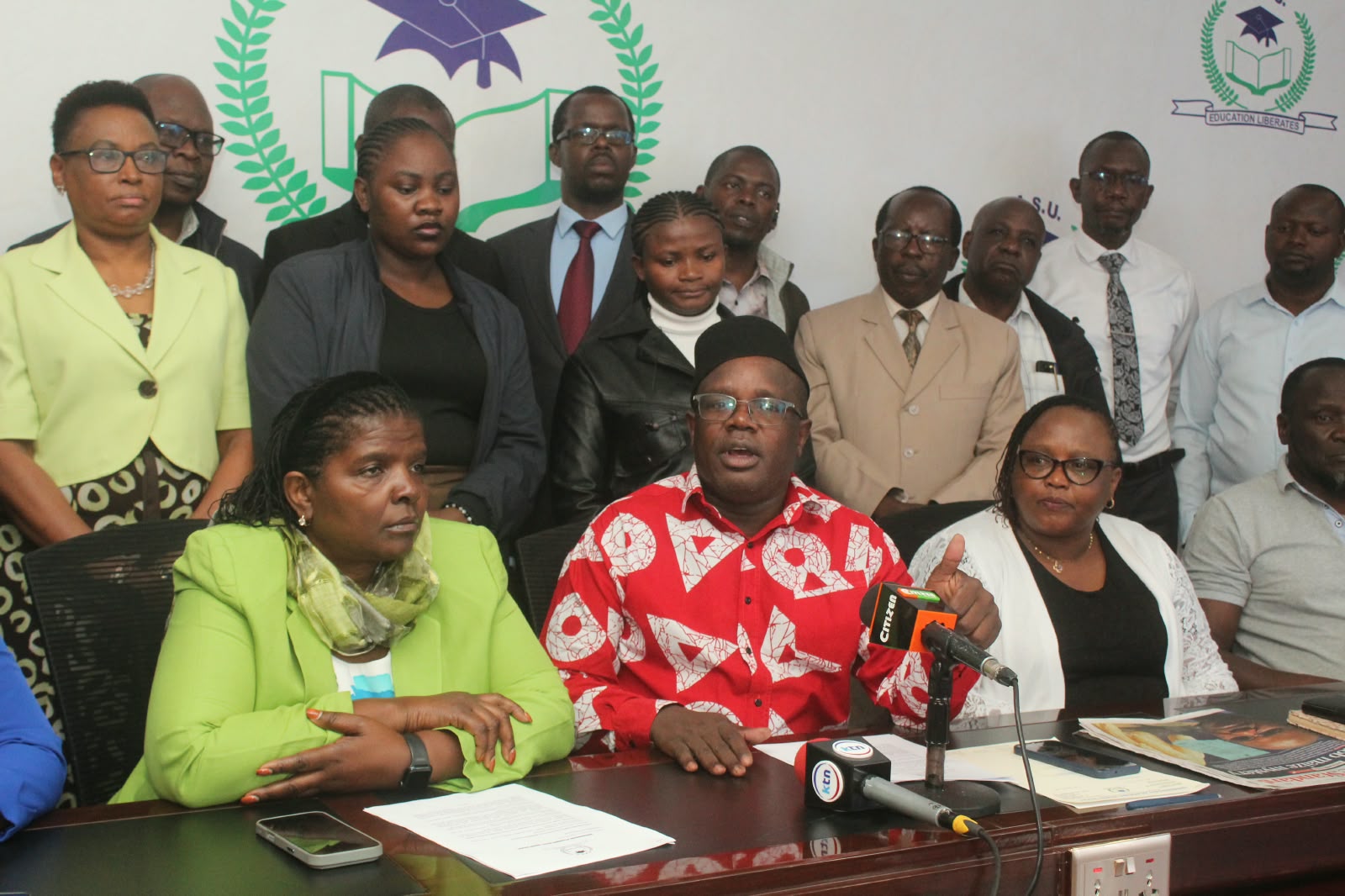


Photo Caption : UASU Secretary General Dr Constantine Wasonga speaks during a media briefing in Nairobi on September 18, 2026.
NAIROBI, September 18, 2026 — The Universities Academic Staff Union (UASU) has given the Government one month to resolve the stalled negotiations for the 2025-2029 Collective Bargaining Agreement (CBA), warning that failure to conclude the process could further strain Kenya’s public university sector.
Speaking during a media briefing in Nairobi on Friday, UASU Secretary General Dr Constantine Wasonga said the union had extended the Government’s window to October 18 to table a substantive counter-proposal, negotiate, sign and implement the agreement.
“We have given them exactly one month, from September 18 up to October 18. Failure to conclude this 2025-2029 CBA, UASU will serve a sentence of five years.”Wasonga said.
The union said negotiations had stalled despite an agreement under the November 2025 Return-to-Work Formula that the parties would conclude the process before the end of 2025.
Wasonga questioned the commitment of some members of the IPUCCF negotiating team, alleging that some vice-chancellors involved in the talks did not have CBAs with their respective UASU chapters.
“How can you negotiate a CBA while in your chapter you don’t have a CBA in the first place? So that is one reason why this CBA has stalled,” he said.
Wasonga also raised concerns over what he described as similarities between recommendations presented by IPUCCF and advice issued by the Salaries and Remuneration Commission (SRC), insisting that the commission should provide independent advice while allowing the two sides to negotiate.
“SRC is an independent commission. They should check our proposal and IPUCCF’s recommendation and give us independent advice. At the same time, the advice should not be final. We should be given room to negotiate.” He said.
On university financing, UASU opposed the use of student fees to fund academic staff salaries and CBAs, arguing that lecturers in public universities are public employees whose remuneration should be funded through the Exchequer.
Wasonga questioned the sustainability of linking staff remuneration to student payments, particularly under the changing university funding model.
“Our salaries should come from the Exchequer, not student fees. Suppose students don’t pay fees? What will happen to our salaries? We have never had other public sector employees being told to generate their fees.” Wasonga said.
The union also opposed the redundancy process at Moi University and called for its immediate suspension pending an independent staffing audit. UASU said the university’s move to reduce staff was inconsistent with its reported need for additional lecturers, including through the recruitment of part-time teaching staff.
Wasonga said universities should address management and staffing challenges before declaring academic staff redundant, particularly professors whose expertise takes years to develop.
“How can academic staff be declared redundant? University is meant for teaching staff and students. Without academic staff, there cannot be a university. The union shall not allow professors to be declared redundant,” he said.
He further criticised what he termed gross financial mismanagement at Moi University, saying concerns raised in Auditor-General reports should be addressed before the institution proceeds with redundancies.
“Correct your financial mismanagement before you talk about redundancy. Read through the Auditor-General’s report and correct it,” Wasonga said.
UASU further criticised the growing reliance on part-time lecturers in public universities, saying the practice was being used to fill vacancies created by inadequate recruitment of permanent academic staff.
Wasonga cited institutions with large student populations but relatively small numbers of full-time academic staff, alongside universities advertising dozens of part-time teaching positions, as evidence of the staffing gaps.
“Part-time teaching is not acceptable. Part-time teaching is compromising quality. How do you admit students when there are no lecturers and we don’t have infrastructure?” He said.
The union also opposed attempts to reduce the retirement age of academic staff, saying universities risk losing experienced academics while continuing to depend on part-time lecturers.
Wasonga said academic work should not be measured by classroom teaching alone, noting that professors are also expected to undertake research and community service.
“The work of a professor is to teach, research and do community service. Workload is not based only on teaching. The workload is teaching, research and community service.” Wasonga said.
UASU called on the Government to urgently address the CBA negotiations, university funding, staffing shortages, part-time teaching, retirement-age concerns and the situation at Moi University, saying the measures were necessary to protect the quality of university education and the welfare of academic staff.