
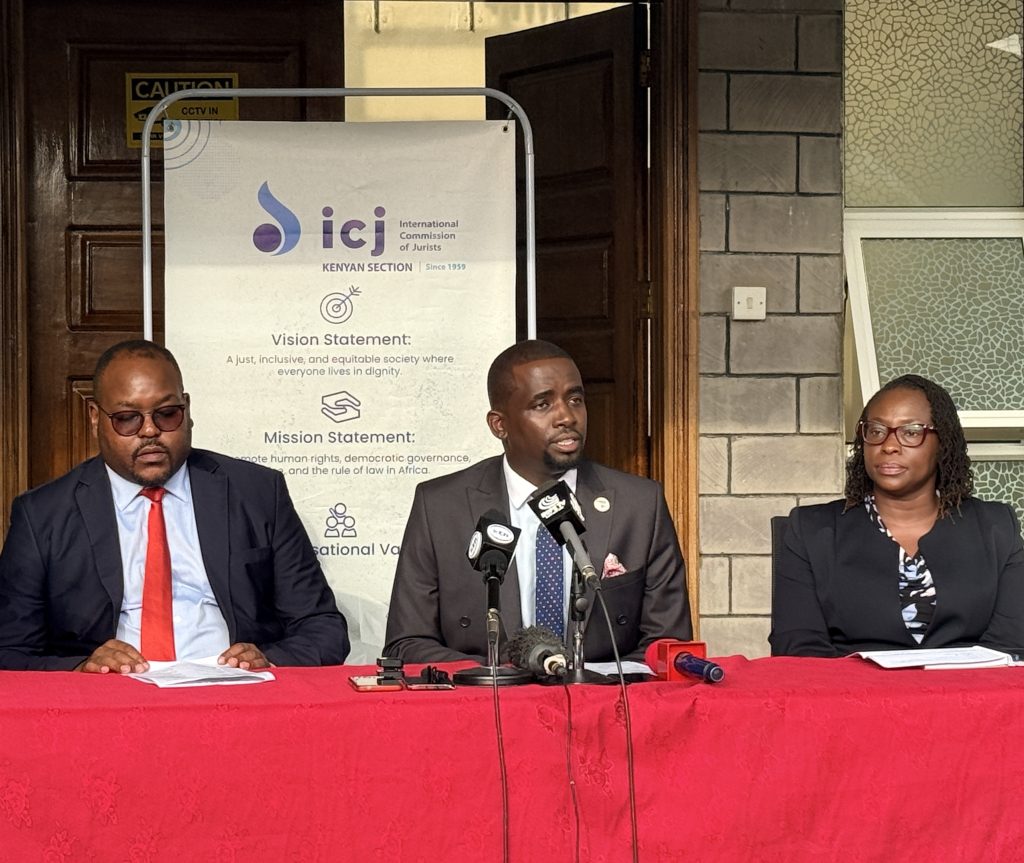
Photo caption:
From left: KHRC Executive Director Demas Kiprono, EALS President Abubakar Mukira and ICJ Chairperson Christine Alai during the release of a joint statement on governance and human rights concerns in Uganda in Nairobi, July 1, 2026.
Regional legal organisations have called on the Government of Uganda to uphold constitutionalism and safeguard fundamental freedoms amid growing concern over reported arbitrary detentions, restrictions on media operations and alleged encroachment on civilian institutions by security agencies.
The organisations warned that the reported developments, if left unaddressed, could undermine constitutional governance, judicial independence and the protection of human rights guaranteed under Uganda’s Constitution and international legal instruments.
The concerns were contained in a joint statement presented by the East Africa Law Society (EALS), national bar associations from across East Africa, the Pan-African Lawyers Union (PALU), the International Commission of Jurists (ICJ), the Kenya Human Rights Commission (KHRC) and other regional legal organisations.
Presenting the joint statement, East Africa Law Society (EALS) President Abubakar Mukira said regional legal organisations were increasingly concerned over reported constitutional and statutory violations affecting media freedom, personal liberty, the legal profession and the rule of law in Uganda.
Mukira said the organisations were not determining criminal liability or making judicial findings but were highlighting constitutional concerns arising from recent developments in Uganda under national, regional and international legal frameworks.
“We are not making judicial findings or determining criminal liability. Our responsibility is to identify prima facie constitutional concerns arising from the reported developments and assess them against national, regional and international legal standards,” he said.
He noted that the reported incidents collectively threaten constitutional governance by eroding fundamental rights and weakening institutions established to safeguard the rule of law.
“The cumulative effect of the reported incidents threatens the foundational principles of constitutional governance, including personal liberty, freedom of expression, media freedom and the independence of the legal profession,” Mukira said.
The organisations cited the reported detention and prosecution of former Ugandan Minister of Ethics and Integrity Dr. Maria Matembe, whom they alleged had been denied bail. They also referred to reported abductions involving Dr. Sara Birete, Eunice Musime and other individuals, alongside the continued prosecution of senior lawyer and former Kampala Mayor Erias Lukwago.
According to Mukira, the reported incidents point to concerns over transparency in detention procedures, judicial independence and observance of constitutional guarantees on due process.
“In Dr. Matembe’s case, there has been no publicly available confirmation regarding the legal basis of her detention, her place of custody or whether constitutionally required safeguards have been observed,” he said.
The organisations argued that deprivation of liberty without prompt disclosure of lawful authority or verifiable custody raises constitutional concerns relating to personal liberty, protection from torture and the right to a fair hearing.
The statement also raised concern over reported disruption of operations at Nation Media Group Uganda outlets, including NTV Uganda, Spark TV and the Daily Monitor, following reports of suspended broadcasting and deployment of security personnel at media premises.
International Commission of Jurists (ICJ) Chairperson Christine Alai said media freedom remains an indispensable pillar of democratic governance and public accountability.
“Press freedom is not a privilege granted by the State. It is a constitutional pillar essential for democratic governance, public accountability and citizens’ right to access information,” Alai said.
She noted that Uganda’s Communications Act vests exclusive authority to regulate broadcasters in the Uganda Communications Commission (UCC), adding that any restriction of licensed media operations must meet constitutional tests of legality, necessity, proportionality, procedural fairness and independent oversight.
Alai also expressed concern over reported interventions by senior military officials in matters ordinarily reserved for civilian institutions.
“The military’s constitutional mandate is limited to protecting national interests and external security, not regulating the media or directing arrests of lawyers,” she said.
She warned that increasing military involvement in civilian regulatory functions risks blurring the constitutional distinction between civilian authority and military command.
Kenya Human Rights Commission (KHRC) Executive Director Demas Kiprono said Uganda’s legal framework clearly assigns regulation of the media to civilian institutions established under the Communications Act and the Press and Journalists Act.
“Any interference outside these civilian statutory institutions raises serious concerns over constitutional non-compliance, unlawful assumption of authority and administrative irregularity,” Kiprono said.
He added that reported interference with legal practitioners and media institutions undermines constitutional guarantees relating to legal representation, access to justice, freedom of expression and civic participation.
Kiprono further observed that Uganda remains bound by regional and international legal obligations, including the East African Community Treaty, the African Charter on Human and Peoples’ Rights, the United Nations Convention Against Torture and other instruments requiring accountability, judicial oversight and effective remedies where rights are threatened.
The organisations called on Ugandan authorities to immediately disclose the legal basis and whereabouts of all detained persons, facilitate access to legal counsel, family members and medical care, restore affected media operations and reaffirm the Uganda Communications Commission’s exclusive mandate over broadcasting regulation.
They further urged the government to end non-statutory interference in civilian regulatory functions, reaffirm constitutional civilian oversight of security agencies and institute independent, transparent and time-bound investigations into all reported violations.
Mukira said respect for constitutional order depends on adherence to the limits imposed by law.
“Constitutional order depends not only on institutions but on faithful adherence to the limits imposed by law. Where detention lacks transparency, statutory mandates are displaced and coercive powers operate outside established legal frameworks, the rule of law comes under serious strain,” he said.
The joint statement was endorsed by the East Africa Law Society, national bar associations across East Africa, the Pan-African Lawyers Union, the International Commission of Jurists, the Kenya Human Rights Commission and other regional legal organisations.
- Agriculture
- Business
- Country
- Culture
- Development
- Economy
- Education
- Energy
- Entertainment
- Environment
- Gender
- Governance
- Health
- Justice
- Labour
- Mining
- National News
- News
- Opinion
- Politics
- Science
- Society
- Sports
- Technology
- Tourism
- Uncategorized
- World