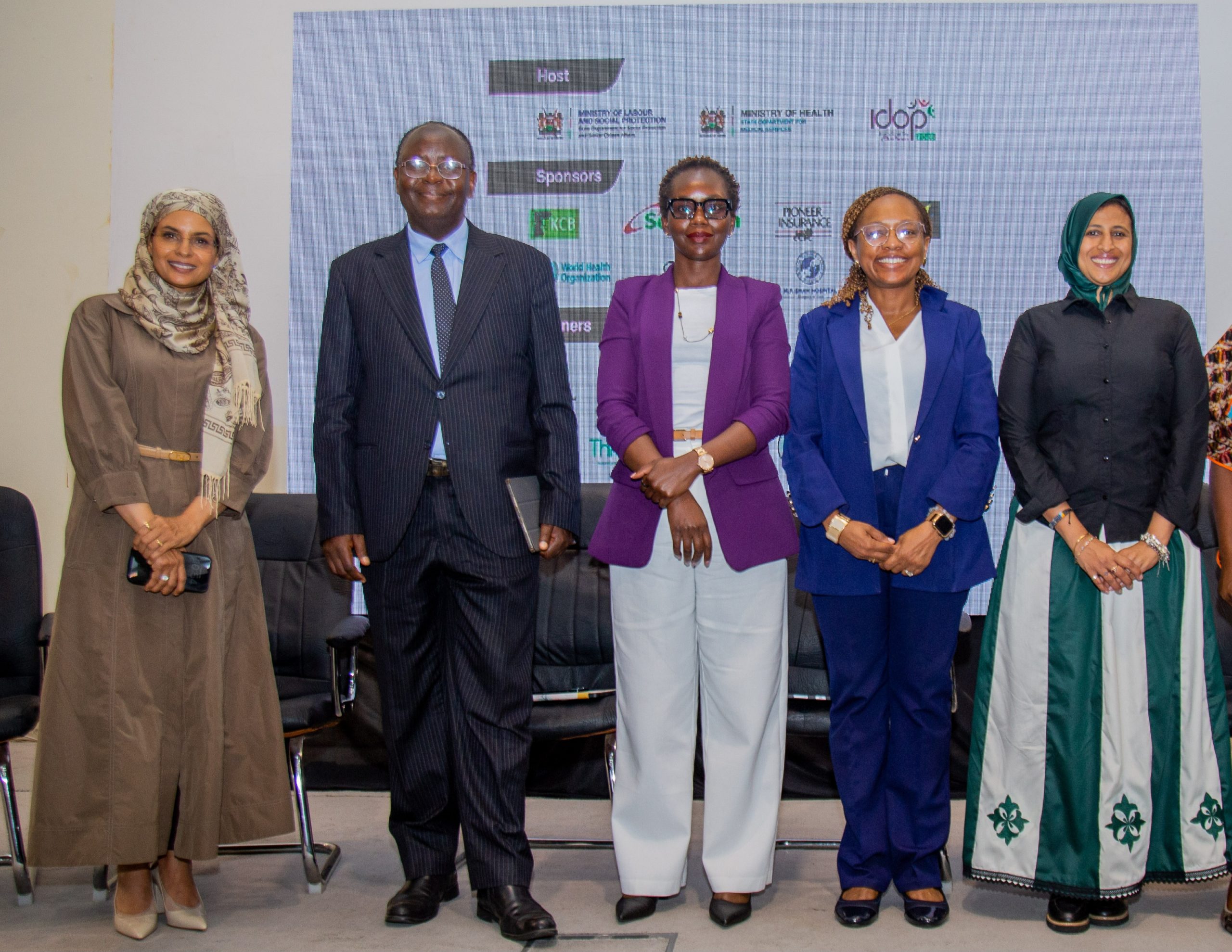


Left to right: Anthony Gitau, Director of Global Community Impact for Sub-Saharan Africa at Johnson & Johnson Foundation; Judith Awinja Aluora, Head of Nursing and Midwifery Services at the Ministry of Health; Aden Duale, Cabinet Secretary for Health; Mary Muthoni, Principal Secretary for Public Health and Professional Standards; and Lister Onsongo, CEO and Registrar of the Nursing Council of Kenya, during the launch of new nursing policy frameworks and the Nurse of the Year Awards at the climax of the International Nurses Week celebrations in Nairobi on May 12, 2026.
NAIROBI, May 12, 2026 — The Government has launched new nursing policy and strategic frameworks alongside a national recognition programme for nurses and midwives aimed at strengthening Kenya’s healthcare workforce, improving professional standards, and advancing Universal Health Coverage (UHC).
The initiatives were unveiled during the climax of the International Nurses Week celebrations in Nairobi under the theme “Our Nurses, Our Future: Empowered Nurses Save Lives,” bringing together healthcare leaders, development partners, county representatives, and nursing professionals from across the country.
Executive Directives and Policy Frameworks
Speaking during the launch, Health Cabinet Secretary Aden Duale described nurses and midwives as the backbone of Kenya’s healthcare system, saying their contribution remains central to the country’s healthcare transformation agenda.
“At this very hour, across our country, from our busiest referral hospitals to the most remote dispensary, a nurse is holding the hand of a frightened patient while a midwife is guiding new life into this world,” Duale said.
He noted that nurses are often the first healthcare workers patients encounter and remain a constant presence during illness, recovery, emergencies, and community care.
“Your work is not ordinary. Your work is extraordinary. It is not transactional, but transformational,” he said.
Duale acknowledged the challenges facing the profession, including staff shortages, heavy workloads, delayed salaries, and emotional strain, but assured nurses that the Government would continue investing in their welfare, professional growth, workforce distribution, and mental health support.
In a major announcement welcomed by nursing professionals, the Cabinet Secretary revealed that the Ministry of Health would initiate the process of establishing a Directorate of Nursing to strengthen representation of nurses within the ministry’s leadership structures.
“For the nurses of the Republic of Kenya, I will write to the Public Service Commission because the Health Act gives the Cabinet Secretary powers to create directorates in consultation with the Director General,” he stated.
The event also marked the official launch of the Nurse of the Year Awards (NOYA), a national recognition platform designed to honour nurses and midwives for excellence, leadership, innovation, compassion, and service in healthcare delivery.
According to organisers, the awards will recognise outstanding professionals in areas including clinical practice, nursing leadership, primary healthcare, education, research, innovation, and entrepreneurship.
The awards process will begin at county level before progressing to regional and national stages, culminating in a national gala scheduled for May 2027.
Institutional Implementation and Workforce Scale
Principal Secretary for Public Health and Professional Standards Mary Muthoni said nurses remain the foundation of healthcare delivery, particularly in rural and underserved areas.
“Nurses constitute 70 percent, if not 90 percent, of all healthcare in the country. In some remote facilities where you may not find any other healthcare worker, you will always find a nurse,” Muthoni said.
She added that the Ministry was implementing reforms aimed at expanding nursing training, improving working conditions, strengthening career progression pathways, integrating digital health competencies, and improving retention within the public health system.
Nursing Union Demands and Systemic Challenges
Despite the celebratory atmosphere, National Nurses Association of Kenya President Collins Otieno Ojwang highlighted persistent challenges affecting nurses, including delayed salaries, inadequate remuneration, and limited leadership opportunities.
“An empowered nurse needs full salary payment on time. An empowered nurse should be adequately remunerated and must enjoy opportunities for professional growth,” Ojwang said.
He called for direct payment of nurses’ salaries from the Exchequer to address delays experienced at county level and urged the Government to fully involve nurses in the implementation of the Social Health Authority programme.
“We are the implementers. Communities come to us and patients come to us for direction, yet nurses are left out while they provide 90 percent of hospital care,” he stated.
Global Partnerships and Stakeholder Support
Development partners also reaffirmed support for strengthening the profession.
Anthony Gitau said nurses remain the critical link between communities and healthcare services.
“We cannot talk about connecting communities to care without nurses because in many cases they are the first and sometimes the only healthcare workers patients meet,” Gitau said.
He added that stakeholders had come together under the Nurse and Midwife Alliance to support nursing leadership, training, and professional development through partnerships and capacity-building programmes.
World Health Organization Kenya Strategic Information Specialist Leonard Cosmas described nurses and midwives as the heart of the health system, saying they remain at the centre of healthcare delivery from birth to recovery and community care.
International Recognition and Professional Dignity
Chairperson of the Nursing Council of Kenya Dabar Abdi Maalim said Kenyan nurses continue to gain international recognition because of their professionalism, quality training, and standards of practice.
“It is important to note that Kenya is among the few countries in the world whose nurses and midwives are globally recognized as excellent professionals,” Maalim said.
He called for increased investment in nursing education, better working conditions, and greater inclusion of nurses in national decision-making processes.
“When nurses are supported, communities thrive. When nurses are respected, healthcare systems grow stronger, and when nurses are empowered, nations prosper,” he said.
The celebrations concluded with renewed calls for stronger collaboration between the Government, county administrations, professional bodies, training institutions, development partners, and healthcare stakeholders to improve the welfare of nurses and strengthen healthcare delivery across the country.