
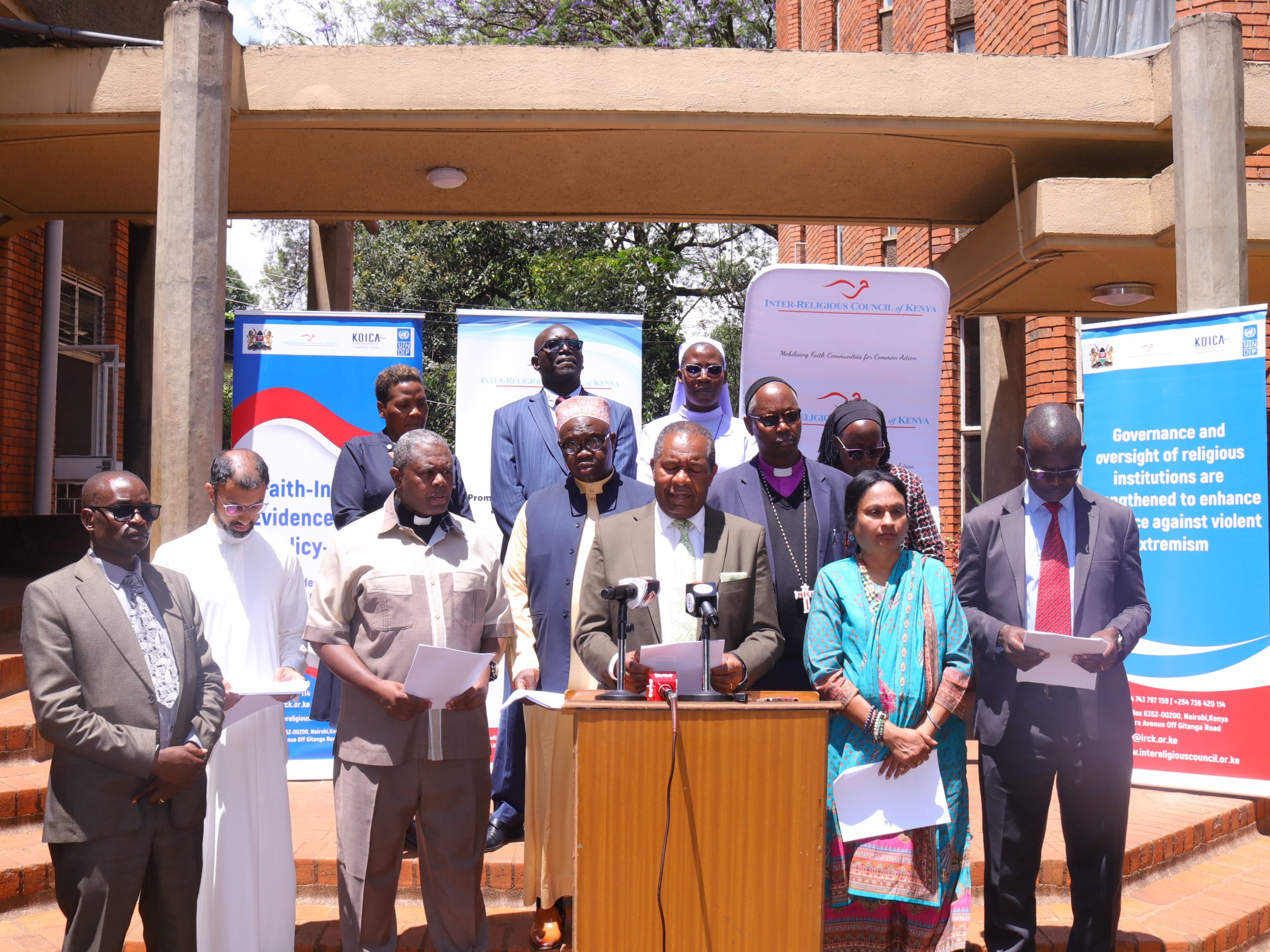
Photo Caption: Bishop Geoffrey Njuguna (center) speaking during the presentation of a joint statement by religious leaders on the state of the nation and preparations for the 2027 General Election in Nairobi.
NAIROBI, November 5th,2026 – Religious leaders have called on Kenyans to reject ethnic mobilisation, political intimidation and hate speech ahead of the August 10, 2027 General Election, warning that inflammatory rhetoric and organised violence could undermine national cohesion and democratic stability.
In a joint statement issued at Ufungamano House in Nairobi on Thursday, the Inter-Religious Council of Kenya (IRCK) expressed concern over the prevailing political environment, citing rising misinformation, shrinking civic space and declining public trust in electoral institutions.
The Council noted that the electoral cycle was unfolding amid economic difficulties, including the high cost of living, public debt exceeding Sh13 trillion and youth unemployment, warning that these challenges could heighten public anxiety and create conditions for unrest.
Bishop Geoffrey Njuguna of the Evangelical Alliance of Kenya (EAK), who presented the opening section of the statement, urged Kenyans to maintain peace and reject attempts to mobilise communities along ethnic, religious and political lines.
“An election is a contest of ideas, not a battle between communities. We therefore appeal to all Kenyans to remain calm, tolerant and united. Your neighbour of a different tribe, faith or political persuasion is not your enemy,” he said.
He also cautioned young people against being recruited to cause chaos, urging them instead to register as voters, participate peacefully and hold leaders accountable through the ballot.
Addressing political conduct, Sheikh Yusuf Abdulhamza of the Supreme Council of Kenya Muslims (SUPKEM) called on political leaders and their supporters to abandon hate speech, ethnic profiling and divisive rhetoric.
“Kenyans are looking for solutions to the cost of living, unemployment and declining public services. Political leaders should sell policies not hate, not fear or division,” he said.
The Council further urged political actors to respect the Electoral Code of Conduct, which is already in force, and honour peace commitments ahead of the official campaign period scheduled to begin on May 29, 2027.
On media freedom, Rev. Fr Charles Kilonzo of the Kenya Conference of Catholic Bishops (KCCB) condemned harassment, intimidation and censorship targeting journalists and media houses.
“We strongly condemn any forms of harassment, intimidation, or censorship directed at media houses and journalists. We call upon the government, security agencies, and all political factions to unconditionally protect media practitioners and guarantee their safety as they fulfill their constitutional mandate to inform the public,” he said.
He also urged media practitioners to uphold professional integrity and responsible journalism, warning against the use of media platforms to spread hate speech, misinformation and divisive propaganda.
On electoral preparedness, Zaheer Abbas Khimji of the Supreme Council of Kenya Muslims’ Asian Affairs Section called on the Independent Electoral and Boundaries Commission (IEBC) to strengthen transparency and public engagement ahead of the polls.
“Trust in an election is built long before polling day. It grows when institutions are transparent, accessible and accountable,” he said.
The religious leaders acknowledged the Commission’s progress, including continuous voter registration, the expansion of diaspora registration to 26 countries and plans for an independent forensic audit of the voter register.
However, they raised concerns over funding gaps, delayed electoral reforms, stalled procurement of election technology and the integrity of results transmission.
They urged IEBC to hold regular public briefings on its preparedness and ensure open procurement processes.
The Council also commended the National Cohesion and Integration Commission (NCIC) for investigating and summoning leaders suspected of breaching the National Cohesion and Integration Act, 2008, saying the law should be applied equally regardless of political affiliation, office or community.
In their commitment, the religious leaders pledged to use churches, mosques, temples and other faith-based platforms to promote peace, tolerance, civic education and voter awareness.
Rev. Kepha Nyandega of the Evangelical Alliance of Kenya, who read the commitment section, said IRCK would strengthen mediation efforts to prevent political disputes from escalating into violence.
“As part of our preparedness, IRCK will mobilise and equip the National Peace and Mediation Team (NPMT), a team of respected religious and nonreligious mediators, trusted across faith, political and ethnic divides to defuse tensions before they escalate and help resolve disputes arising from party nominations, campaigns and results,” he said.
The Council said the mediation team would work with the NCIC, local peace committees, security agencies and other peacebuilding institutions through shared early-warning and rapid-response arrangements.
The religious leaders urged Kenyans to approach the 2027 General Election as one nation, emphasising that peace was the responsibility of every citizen, leader and institution.
They reaffirmed their commitment to supporting a free, fair, credible and peaceful election.